
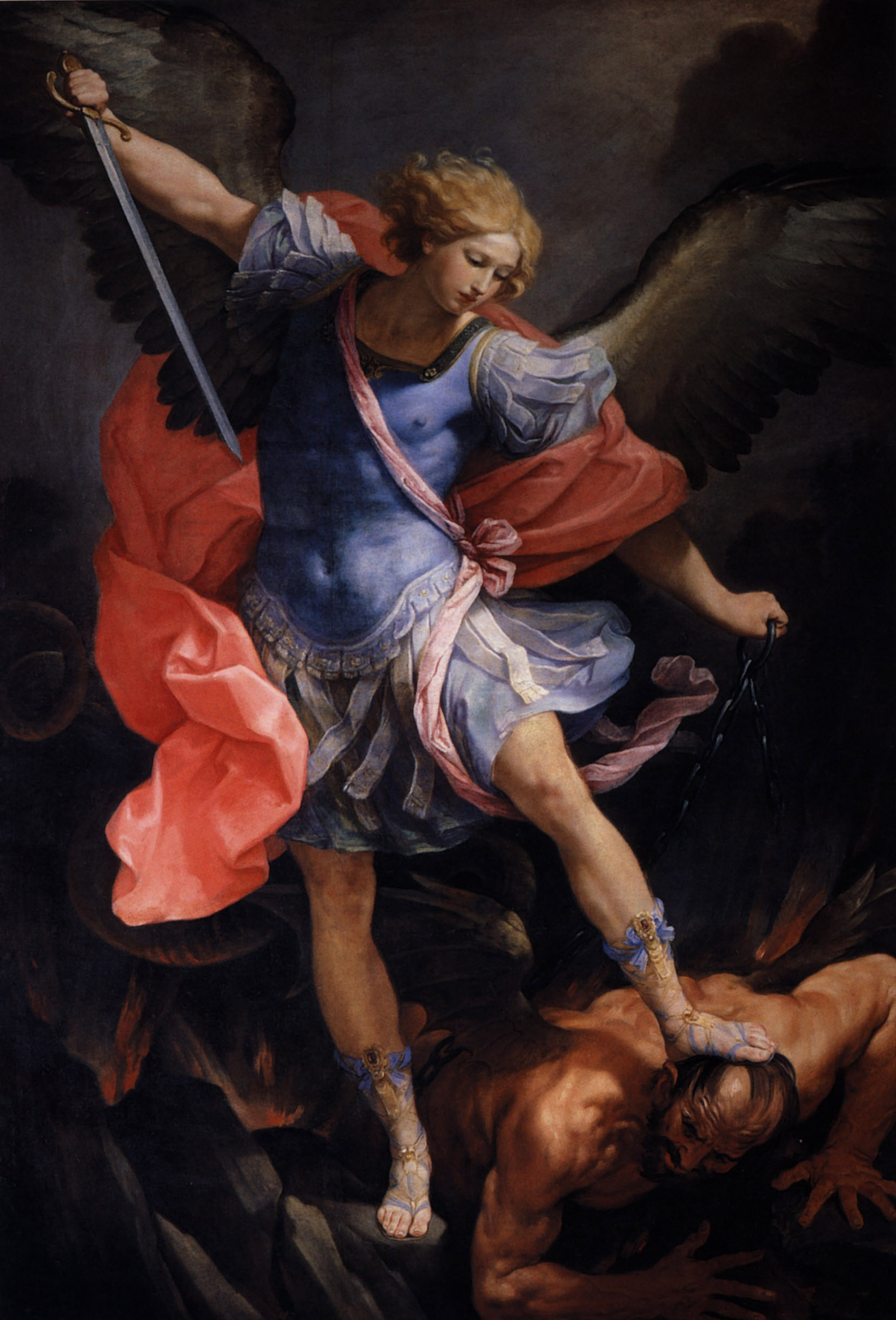
His name is a question, not a title: <em>Mi-ka-el</em>, 'Who is like God?' — the challenge flung at the angel who wanted to be. Scripture names him four times. Daniel calls him 'one of the chief princes' and 'the great prince who standeth for the children of thy people' (Daniel 10:13, 10:21, 12:1). Jude records that he disputed with the devil over the body of Moses and did not dare to bring a railing judgement, but said only, 'The Lord command thee' (Jude 9). The Apocalypse gives him the war: 'Michael and his angels fought with the dragon, and the dragon fought and his angels: and they prevailed not, neither was their place found any more in heaven' (Apocalypse 12:7–8).
The Church drew three offices from those verses and has kept all three. He is the defender of the people of God, which is why his prayer is a prayer of battle. He is the guardian of souls leaving this world — the Offertory of the old Requiem asks that 'the standard-bearer Michael bring them into the holy light', and the scales he carries in art weigh them. And he is the patron of the Church herself, a title Leo XIII invoked when he composed the prayer said after every Low Mass from 1886 to 1965.
His cult is older in the West than any other angel's. The sanctuary on Monte Sant'Angelo in the Gargano dates its foundation to apparitions to Bishop Laurentius Maioranus beginning in 490; by tradition the grotto was never consecrated by human hands, because Michael consecrated it himself. Mont-Saint-Michel was founded in 708 after Aubert, bishop of Avranches, saw him in a dream. The feast of 29 September is the dedication, in the fifth or sixth century, of a basilica on the Salarian Way outside Rome; the calendar of 1969 joined the other two archangels to it.