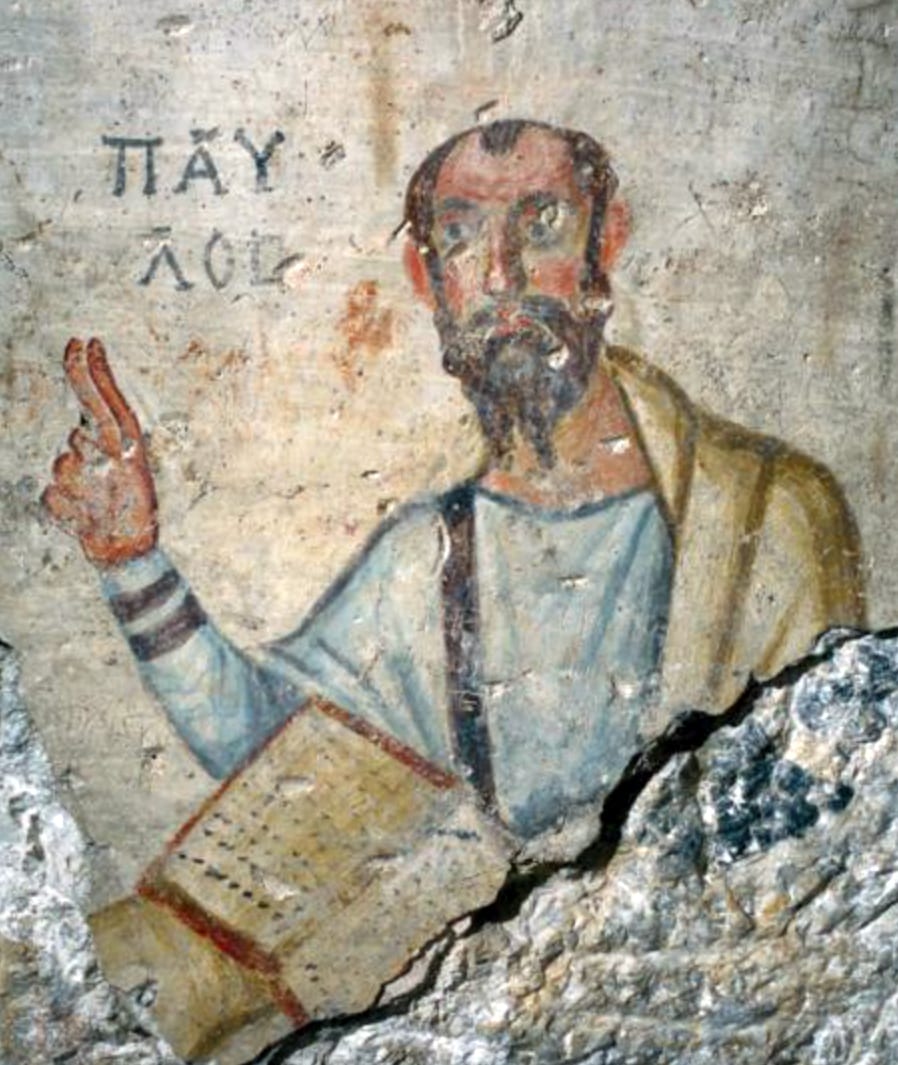
Saul of Tarsus was born to a Jewish family of the diaspora — a Pharisee, a Roman citizen by birth, trained at the feet of Gamaliel in Jerusalem. He held the cloaks of those who stoned Stephen and 'breathed threats and murder against the disciples of the Lord' (Acts 9:1), bearing letters of authority to arrest Christians at Damascus.
On the road to Damascus he was struck blind by a light from heaven; a voice called: 'Saul, Saul, why do you persecute me? I am Jesus, whom you are persecuting.' Three days later, in Damascus, a Christian named Ananias laid hands on him; the scales fell from his eyes, and he was baptised.
Over the next thirty years he made three great missionary journeys across Asia Minor, Greece, and the Aegean, planting churches that he then kept by his letters — thirteen of which are preserved in the New Testament. He was shipwrecked, beaten, imprisoned, stoned, and ultimately taken to Rome under arrest as a citizen appealing to Caesar. There, sometime in the mid-60s under Nero, he was beheaded at the place now called Tre Fontane.
The Conversion on the Road to Damascus
c. AD 33–36The defining miracle of his life — the blinding light and the voice of the risen Christ on the road to Damascus (Acts 9; 22; 26). Recounted three times in Acts and alluded to throughout his own letters.
The Earthquake at the Philippian Jail
Imprisoned at Philippi after exorcising a slave-girl, Paul and Silas sang hymns in their stocks at midnight. A sudden earthquake shook the foundations of the prison; the doors opened, the chains fell off. The Roman jailer drew his sword to kill himself, but Paul cried out, and the jailer that night was baptised with his whole household (Acts 16).
The Viper at Malta
Shipwrecked on Malta, Paul gathered sticks for a fire. A viper, driven out by the heat, fastened on his hand. The islanders waited for him to swell up and die. He shook off the snake into the fire and was unharmed (Acts 28:1–6). Many sick of the island were then brought to him and healed.
Raising Eutychus at Troas
Preaching late into the night at Troas, Paul kept the assembly until midnight. A young man named Eutychus, sitting in a third-storey window, fell asleep, fell out, and was picked up dead. Paul went down, took him in his arms, and said: 'Do not be alarmed, for his life is in him' (Acts 20:7–12). The young man was alive.
Sources & Further Reading