
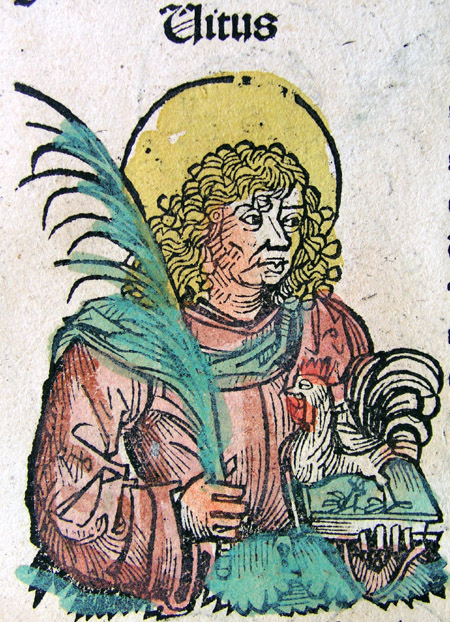
Vitus (Latin Vitus, 'lively') is — per the traditional Acts of his martyrdom (composed in the 6th or 7th century but reflecting earlier oral tradition) — a young Sicilian boy of about 12 years, the son of a pagan Sicilian senator named Hylas, who had been secretly converted to Christianity by his tutor Modestus and his Christian nurse Crescentia. The historical reliability of the specific details of the Acts is much debated; the substantial pre-medieval cult is firmly attested.
When the young Vitus's father discovered the conversion he attempted to dissuade his son with extreme violence; failing, he denounced him to the Sicilian Roman provincial authorities. The three (Vitus, Modestus, Crescentia) fled to Lucania in southern Italy and lived there briefly in clandestine community. They were eventually arrested under Diocletian's edicts and taken to Rome, where Vitus is said to have cured the Emperor Diocletian's son (or other imperial relative) of demonic possession — for which gesture Diocletian rewarded him by demanding his renunciation of Christianity. Vitus refused and was tortured: thrown into a cauldron of boiling oil and pitch (which became cool); thrown to a lion (which licked his hand); and finally killed by being stretched on the rack.
His cult became extraordinarily widespread in the medieval period, particularly in Germany and the Slavic Catholic territories. He is one of the celebrated Fourteen Holy Helpers (the Vierzehnheiligen) of the medieval German devotional tradition. His relics were translated to Saxony in the 9th century by Abbot Fulrad of Saint-Denis, then to Corvey in 836, then to Prague (where Wenceslas I of Bohemia obtained a single relic in the 10th century, which became the foundational treasure of the great Cathedral of Sts. Vitus, Wenceslaus, and Adalbert at Prague — the principal Czech national cathedral and pilgrimage site).
The medieval German popular association of Vitus with dancing — and his consequent universal patronage of dancers and of sufferers of chorea — derives from a 16th-century German Bavarian folk custom in which sufferers from Sydenham's chorea (a movement disorder, often a complication of childhood rheumatic fever) and other involuntary-movement neurological disorders would dance before his statue on his feast day for cure. The medical term St. Vitus' Dance preserves the association.