
Jesus, I trust in You — the image, the chaplet, the hour, and the feast
The devotion given through St. Faustina Kowalska between 1931 and 1938: the image of the Merciful Christ with its red and pale rays, the chaplet prayed on rosary beads, the Hour of Great Mercy at three o'clock, and the feast the Church now keeps on the Sunday after Easter.
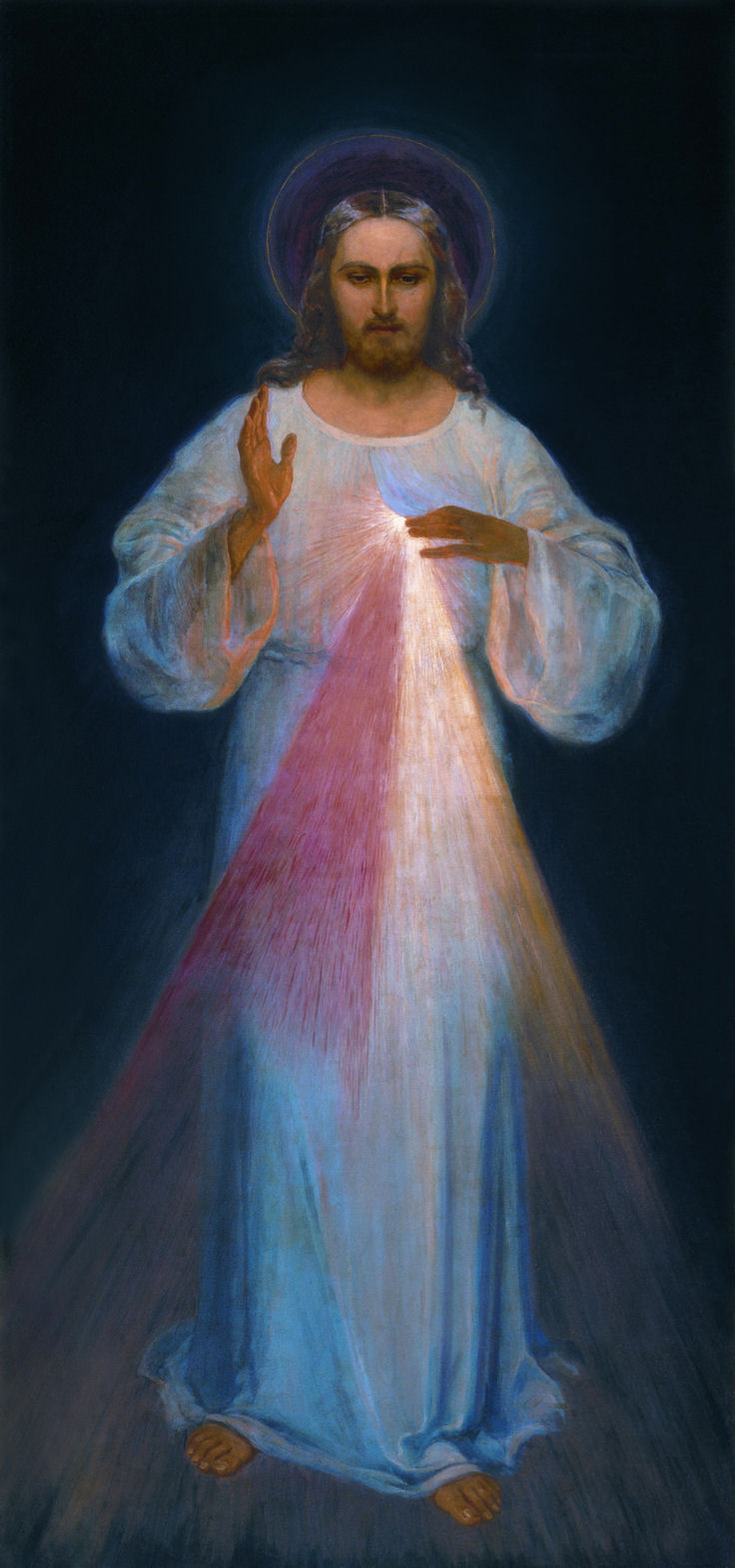
The image, and what its rays mean
On the evening of February 22, 1931, in the convent at Płock, Sister Faustina saw Christ clothed in white, one hand raised in blessing, the other touching His breast, from which two great rays streamed — one red, one pale. She recorded His words: that she should paint an image after the pattern she saw, and sign it <em>Jesu, ufam Tobie</em> — Jesus, I trust in You.
She asked what the rays meant and was told: the pale ray stands for the water which makes souls righteous, the red ray for the blood which is the life of souls — Baptism and the Eucharist, the two sacraments that flowed from the opened side on Calvary (John 19:34). This is why the image is not a portrait of a feeling. It is a picture of the sacraments, and of the Heart they come from.
Faustina could not paint. In 1934, under the direction of her confessor Blessed Michał Sopoćko, the artist Eugeniusz Kazimirowski painted the first image at Vilnius, with Faustina describing and correcting it. She wept at how far it fell short of what she had seen, and was answered that the greatness of the image lies not in the beauty of the paint but in the grace of God.
The chaplet, the hour, and the novena
In September 1935, at Vilnius, Faustina received the prayer now known as the Chaplet of Divine Mercy — prayed on ordinary rosary beads, offering to the Father the Body and Blood, Soul and Divinity of Jesus Christ in atonement for the sins of the world. It is short, it is entirely orthodox in its wording, and it is the reason a great many Catholics who never make it through a full Rosary still pray daily.
With it came the Hour of Great Mercy — three o'clock in the afternoon, the hour of the death on the Cross — and the Novena to the Divine Mercy, prayed from Good Friday to the Saturday before the feast, each of its nine days carrying a different company of souls to the Heart of Christ: sinners, priests and religious, the devout, the unbelieving, the separated, the meek, those who venerate His mercy, the souls in purgatory, and the lukewarm.
The prohibition, and the lifting of it
Faustina died of tuberculosis on October 5, 1938, aged thirty-three. Her diary — later published as <em>Divine Mercy in My Soul</em> — spread quickly, and so did the devotion, carried by Polish soldiers and refugees across the world during the war.
Then, on March 6, 1959, the Holy See issued a Notification forbidding the spreading of images and writings that promote the devotion in the forms proposed by Sister Faustina. The reasons were prudential and, as it turned out, partly a matter of a bad text: the Italian translation of the diary on which Rome worked was defective, and read in places as though the devotion were being set above the sacraments. The ban held for nineteen years, and Faustina's own sisters obeyed it.
The case was reopened by the Archbishop of Kraków, Karol Wojtyła, who commissioned a full theological examination of the original Polish. On April 15, 1978, the Congregation for the Doctrine of the Faith declared the prohibition no longer binding. Six months later that archbishop was elected pope. This history is worth telling rather than hiding: it shows a Church that examines, that is willing to say no, and that is willing to look again — which is precisely why her yes is worth something.
The feast, and the Sunday John Paul II died
On April 30, 2000, canonizing Faustina before a crowd in St. Peter's Square, John Paul II declared: 'It is important then that we accept the whole message which comes to us from the word of God on this Second Sunday of Easter, which from now on throughout the Church will be called Divine Mercy Sunday.' In 2002 the Apostolic Penitentiary granted a plenary indulgence for the day, under the Church's ordinary conditions.
John Paul II died on the evening of April 2, 2005 — the vigil of Divine Mercy Sunday, with the feast's first Vespers already being sung. The homily he had prepared for the next day was read at his funeral Mass in his absence.
The Promises
The Divine Mercy promises are among the most extraordinary in the Church's devotional life, and they deserve to be read exactly as the Church reads them — generously, and without turning grace into a transaction.
"The soul that goes to Confession and receives Holy Communion on the Feast of Mercy shall obtain the complete forgiveness of sins and punishment."
This is the promise people find hardest to believe, and it is the one the Church has effectively ratified: in 2002 the Apostolic Penitentiary attached a plenary indulgence to Divine Mercy Sunday — and a plenary indulgence is precisely the remission of all temporal punishment due to sin already forgiven. What the diary promises in the language of heaven, the Church grants in her own established terms. The ordinary conditions apply, and they are the same ones that make any grace fruitful: sacramental confession, Communion, prayer for the Holy Father, and a heart genuinely detached from sin.
"When they say this Chaplet, it will please Me to grant everything they shall ask for — and when it is said in the presence of the dying, He will stand between His Father and the dying person, not as the just Judge but as the Merciful Saviour."
Faustina records being sent repeatedly to the dying with this prayer. The Church has never defined the promise, but she has done what she does when she trusts a devotion: canonized its recipient, indulgenced its feast, and let it be preached everywhere. Prayed at a deathbed, the chaplet asks the Father to look at His Son rather than at the dying man — which is the safest prayer any of us will ever make.
"Whoever venerates the image of the Divine Mercy will not perish."
Read as the Church reads every such promise, and as the image itself insists: the veneration meant is trust, and the signature under the image is not a slogan but the condition — <em>Jesus, I trust in You</em>. An image kept on a wall while the heart refuses mercy to others is contradicted by the devotion's own second half, in which Christ asks for deeds of mercy, words of mercy, and prayer for mercy.
Living the Devotion
- 1.Keep the feast: go to Confession in the days before, receive Communion on Divine Mercy Sunday, and pray for the Holy Father's intentions.
- 2.Pray the chaplet on ordinary rosary beads — one decade's worth of beads carries it, and it takes about seven minutes.
- 3.Keep the Hour of Great Mercy at three o'clock, even if only for the length of a Glory Be; the Church has no rubric for it and asks only that it be a turning of the mind to the Cross.
- 4.Pray the novena from Good Friday to the Saturday before the feast, taking one company of souls each day.
- 5.Do the second half: Christ asked for deeds of mercy, words of mercy, and prayer for mercy — at least one of the three every day.
In the Words of the Popes
"From now on throughout the Church this Second Sunday of Easter will be called Divine Mercy Sunday. Divine Mercy reaches human beings through the heart of Christ crucified."
"Mercy is the central nucleus of the Gospel message; it is the very name of God, the face with which He revealed Himself in the Old Covenant and fully in Jesus Christ."
"The Church's very credibility is seen in how she shows merciful and compassionate love. Mercy is the beating heart of the Gospel."