
Mary conceived Christ without loss of virginity, bore Him without loss of virginity, and remained a virgin for the whole of her life — the ancient formula: virgin before the birth, in the birth, and after the birth.
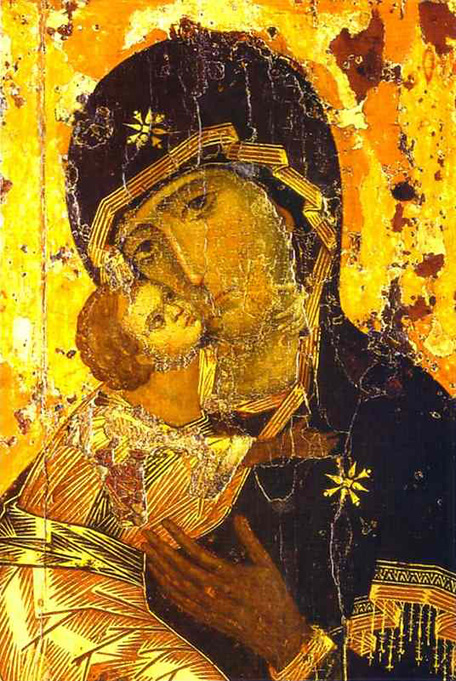
“If anyone does not properly and truly confess in accord with the holy Fathers, that the holy Mother of God and ever Virgin and immaculate Mary in the earliest of the ages conceived of the Holy Spirit without seed, namely, God the Word Himself specifically and truly, who was born of God the Father before all ages, and that she incorruptibly bore [Him], her virginity remaining indestructible even after His birth, let him be condemned.”
Divinely revealed and taught constantly by the Church's ordinary and universal magisterium, without ever having required a formal definition — usually because nobody prominent enough ever denied it. It binds no less firmly than a defined dogma; it has simply never needed the canon.
The Scripture it rests on
“And Mary said to the angel: How shall this be done, because I know not man?”
Luke 1:34 →“Behold a virgin shall conceive, and bear a son, and his name shall be called Emmanuel.”
Isaiah 7:14 →“This gate shall be shut, it shall not be opened, and no man shall pass through it: because the Lord the God of Israel hath entered in by it.”
Ezechiel 44:2 →“And he knew her not, till she brought forth her first born son: and he called his name Jesus.”
Matthew 1:25 →“He saith to his mother: Woman, behold thy son. After that, he saith to the disciple: Behold thy mother. And from that hour, the disciple took her to his own.”
John 19:26–27 →The oldest of the Marian beliefs
Perpetual virginity is attested earlier and more widely than any other Marian doctrine. It is in the second-century Protoevangelium of James — not Scripture, but evidence of what Christians in about 150 already assumed. It is defended by St. Jerome against Helvidius in 383 with the argument still used today, and it is one of the very few Marian doctrines that the Reformers continued to hold after the break with Rome.
In the councils' own words
The word the Church chose was aeiparthenos, ever-virgin, and by the sixth century it was simply part of how a council named her. The Second Council of Constantinople in 553 condemned anyone who would not confess that the Word “was made flesh of holy and glorious Mary, mother of God and ever-virgin, and was born from her”, and again anyone who denied that “the holy and glorious ever-virgin Mary is the mother of God”.
The Lateran Council of 649, under Pope St. Martin I, spelled the belief out in its three parts, and that canon is the definition printed above. She “conceived of the Holy Spirit without seed” — virgin before the birth; she “incorruptibly bore” Him — virgin in the birth; and her “virginity remaining indestructible even after His birth” — virgin after it. That threefold shape, ante partum, in partu, post partum, is what the Church has meant by the word ever since. Martin I paid for that council with his life: seized by the emperor whose theology it had condemned, he died in exile in the Crimea in 655, the last pope venerated as a martyr.
The brothers of the Lord
The standing objection is the Gospels' references to Jesus's adelphoi — brothers — and it deserves a straight answer rather than a brush-off. Three things bear on it. First, neither Hebrew nor Aramaic has a word for cousin; brother covers the whole range of male relatives, and the Greek of the Gospels follows Semitic usage, as when Lot is called Abraham's brother though he is his nephew. Second, two of the named 'brothers', James and Joses, are identified in Matthew 27:56 as sons of another Mary. Third, at the Cross, Jesus entrusts His mother to John — an act that would be a public insult to surviving brothers, and is inexplicable if she had other sons.
Jerome made the first of those points in 383 and has never been improved on: “In Holy Scripture there are four kinds of brethren — by nature, race, kindred, love.” On Matthew's “knew her not till”, he observed that “the words knew and till in the language of Holy Scripture are capable of a double meaning”, and pointed to God's word in Isaiah, “Even to your old age I am the same” — which does not mean He changes afterwards. He went one step further than most Catholics now would: “Joseph himself on account of Mary was a virgin, so that from a virgin wedlock a virgin son was born.”
None of this compels the conclusion by itself, and the Church does not rest the doctrine on the argument; she rests it on the tradition and defines it. But the objection is not the checkmate it is often presented as.
The Reformers kept it
This is the Marian doctrine the sixteenth century did not throw out. Luther, answering the charge that he had denied it, wrote in 1523 that when Matthew says Joseph did not know Mary until she had borne her son, “it does not follow that he knew her subsequently; on the contrary, it means that he never did know her”; and, preaching on John years later, that “Christ was the only Son of Mary, and the Virgin Mary bore no children besides Him.” Calvin, commenting on the same verse, noted that Helvidius had built his case on it and concluded that “no just and well-grounded inference can be drawn from these words of the Evangelist, as to what took place after the birth of Christ.”
The doctrine's later disappearance from most Protestant teaching happened without a Reformer to lead it. It was not argued away; it was let go.
What it does not mean
A great deal of what people believe the Church teaches, and reject, is something she has never taught.
It implies that marriage or the marital act is unclean.
The Church has defined marriage a sacrament and condemned as heresy the view that it is impure. Mary's virginity is a sign of total consecration, not a verdict on anyone else's vocation.
Matthew says Joseph knew her not 'until' she brought forth her son, which implies afterwards he did.
Greek and Hebrew 'until' carries no such implication — 2 Samuel 6:23 says Michal had no child 'until the day of her death'. It marks what is being asserted up to the point in question, and says nothing about after. Calvin, no friend of Rome, read the verse the same way.
The Church rests the doctrine on a convenient mistranslation of 'brothers'.
She rests it on the tradition and the definition, and says so. Jerome's point about 'brethren' is an answer to an objection, not the foundation: it shows the objection does not compel its conclusion, and the Church has never claimed more for it than that.
Why it matters
- ❁It shows what total availability to God looks like in a single life — a self given whole, and not in part.
- ❁It underlines that the Incarnation was God's initiative from beginning to end and owed nothing to human planning.
- ❁It is the doctrine that Catholics and the first Protestants still shared, which is a useful thing to remember in an argument.