
The Chaplet of Divine Mercy
1935 · St. Faustina
Prayed on ordinary rosary beads, offering the Father the Body and Blood, Soul and Divinity of His Son — this site prays it step by step, with the Vilnius image before your eyes.
The Psalter of Mary — the Gospel prayed on a string of beads
One hundred and fifty Hail Marys in decades, each decade held to a mystery of Christ's life — the poor man's Psalter, the family's evening prayer, the weapon of Lepanto, and the most commended devotion in the history of the Church.
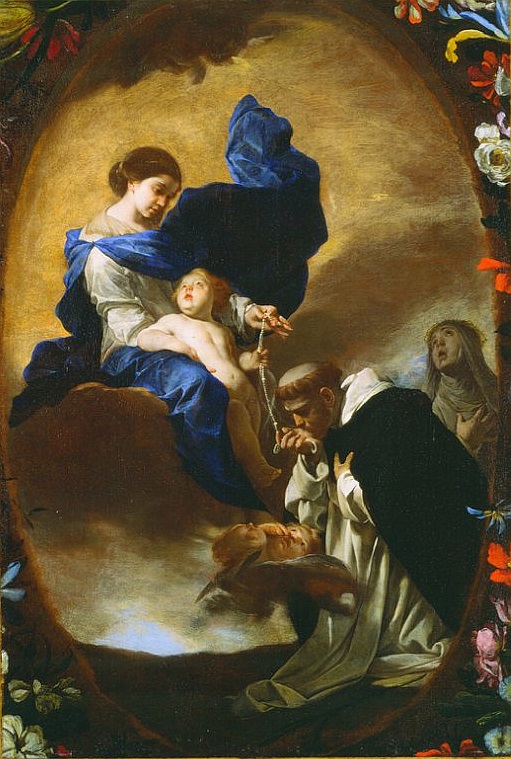
The Rosary is the Gospel on a string. Its hundred and fifty Hail Marys mirror the hundred and fifty psalms — which is why the medieval world called it the Psalter of Mary, the psalter of those who could not read. But the repetition is not the prayer; it is the pavement under the prayer. While the lips keep the rhythm, the heart walks through the mysteries — the Incarnation, the public ministry, the Passion, the glory of the Resurrection — with Mary, who 'kept all these words, pondering them in her heart' (Luke 2:19).
Paul VI called it 'a compendium of the entire Gospel,' and that is its genius: in fifteen minutes, an unlettered farmhand and a Doctor of the Church pray the same complete arc of salvation. The beads are not magic; they are a handrail — they free the mind from counting so it can contemplate.
The beloved tradition holds that the Blessed Virgin gave the Rosary to St. Dominic of Caleruega around 1214, as his weapon against the Albigensian heresy — a tradition the popes have honored in encyclical after encyclical, and painters in a thousand canvases of Our Lady handing down the beads.
What do the records show? The devotion's elements grew across centuries: desert monks counting prayers on pebbles and knotted cords; the psalters of Our Fathers and Hail Marys of the twelfth century; the Carthusian Dominic of Prussia attaching Gospel meditations to the Aves in the fifteenth; and the Dominican Blessed Alan de la Roche — two hundred and fifty years after St. Dominic — preaching the tradition of Dominic's vision and founding the first Rosary confraternities that spread the devotion through Christendom. As with the scapular, the Church's confidence does not hang on one vision's paper trail: the Rosary is Dominican to its marrow — preached, organized, and carried across the world by the Order of Preachers — and what is certain outweighs what is uncertain: seven centuries of the Church commending this prayer, and heaven appearing to agree at Lourdes and Fátima, where Our Lady came with the beads in her hands.
On October 7, 1571, the outnumbered fleet of the Holy League met the Ottoman navy at Lepanto — the largest naval battle of the age, with the Mediterranean's future in the balance. Pope St. Pius V, a Dominican, had asked all Christendom to pray the Rosary for the fleet; the rosary confraternities of Rome processed that morning. The victory, complete and against expectation, was credited by the pope not to admirals but to the Advocate: he instituted the feast of Our Lady of Victory, soon renamed Our Lady of the Rosary, kept on October 7 to this day. The catalogue tells the battle in full — and its stranger successors, from the siege of Vienna to the Jesuits of Hiroshima who prayed the daily Rosary and walked away from the atomic blast.
Leo XIII wrote twelve encyclicals on the Rosary — more documents than any pope has devoted to any other devotion — and consecrated October as its month. At Fátima in 1917, in each of the six apparitions, Our Lady asked for the daily Rosary, naming herself in the last: 'I am the Lady of the Rosary.' Pius XII called it 'the compendium of the entire Gospel'; St. John XXIII prayed all fifteen decades daily as pope; and St. John Paul II, who credited the Rosary with carrying him through the darkest hours of the twentieth century, gave it the Luminous Mysteries in 2002 and asked families to recover it: 'The family that prays together stays together — the Rosary is a prayer of and for the family.'
Read these as the Church reads them: the Rosary's surest promises are the ones built into what it is — the Gospel contemplated cannot fail to sanctify. The rest are shown with their standing.
"The Fifteen Promises of Our Lady to those who pray the Rosary — protection, growth in virtue, deliverance from purgatory, and final perseverance among them."
The list descends from the writings associated with Bl. Alan de la Roche in the fifteenth century, and the Church has never formally pronounced on it — it circulates with historical imprimaturs as pious tradition, not as magisterial teaching. What the promises describe, however, is simply what the Church herself teaches the Rosary does for a soul that prays it faithfully; the substance is safer than the parchment.
"The Church grants a plenary indulgence, under the usual conditions, for praying five decades in a church, in a family, or in a religious community or pious association."
This is the promise with the Church's full signature on it: her own treasury, formally attached to the family and communal Rosary.
"'Pray the Rosary every day to obtain peace for the world.' — Our Lady at Fátima"
Fátima carries the Church's formal approval, and its request is the modern charter of the devotion: the daily Rosary, asked for by name, six times, by the Lady who called herself the Lady of the Rosary.
"It has always been the habit of Catholics in danger and in troublous times to fly for refuge to Mary... the Rosary, by an admirable arrangement, unites in one the salutation of the Angel and the meditation of the mysteries of our salvation."
"The Rosary is my favorite prayer. A marvelous prayer! Marvelous in its simplicity and its depth... Against the background of the words Ave Maria the principal events of the life of Jesus Christ pass before the eyes of the soul."
The Rosary is the queen of a family of counted prayers — each order and devotion stringing its own beads.
Prayed on ordinary rosary beads, offering the Father the Body and Blood, Soul and Divinity of His Son — this site prays it step by step, with the Vilnius image before your eyes.
Seven decades for the Seven Joys of Our Lady — from the Annunciation to her Assumption and Coronation — born, tradition says, from a novice's vision of Mary crowning him with roses.
Seven groups of seven Hail Marys, one for each sorrow of the Mother of God — the bead-prayer of the Black Scapular's spirituality.
'Lord Jesus Christ, Son of God, have mercy on me, a sinner' — prayed on the knotted komboskini of the Eastern monks: the East's own river of repetition flowing toward unceasing prayer.