Movement 4 of 4 · 43 prophecies

Resurrection, Ascension, the Spirit, and the Kingdom

The Holy One would not see corruption; He would ascend on high and sit at the right hand; the Spirit would be poured out on all flesh; and the nations would stream to the mountain of the Lord's house — the fifty days from Easter to Pentecost, and the Church that followed, foretold.

His body would not see corruption

David sang that God would not abandon his Holy One to Sheol nor let him see decay (Psalm 16:10); Peter at Pentecost and Paul at Antioch argued that David's tomb was still occupied, so the psalm spoke of Christ, raised before his flesh could corrupt.

The exegetical core of the Church's first sermon (Acts 2).
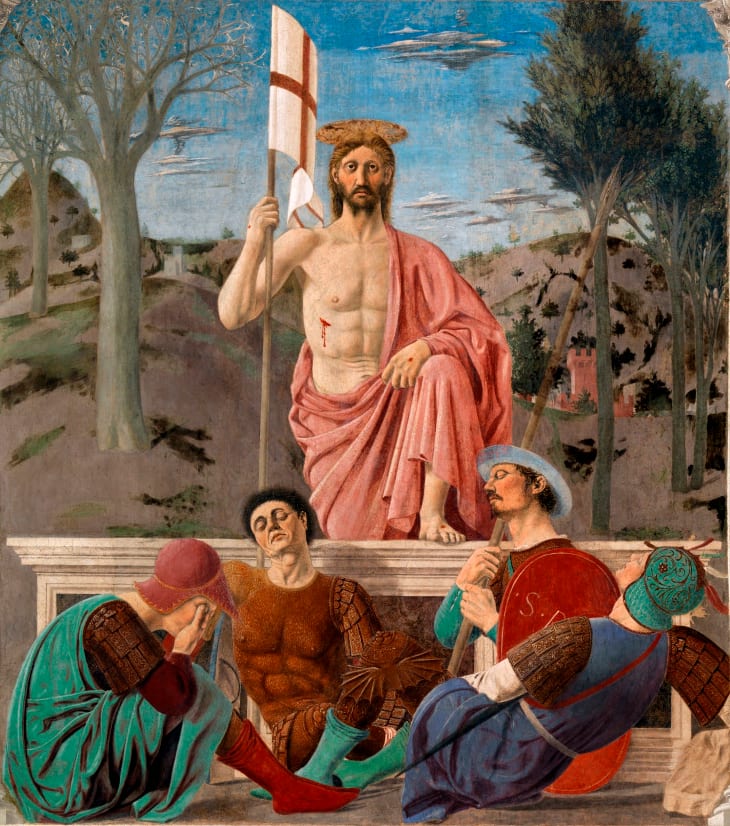
Raised on the third day — the sign of Jonah

Hosea's 'on the third day he will raise us up' and Jonah's three days in the fish were read by Jesus himself as the pattern of his burial and resurrection 'according to the Scriptures.'

Jonah 1:17 is numbered 2:1 in Catholic and Hebrew Bibles. Genesis 22:4 (Isaac received back 'on the third day', Heb 11:19 'in a figure') is a type, not a prediction.

The slain Servant would see his offspring and prolong his days

After his soul is made a guilt-offering and he is cut off from the land of the living, Isaiah's Servant 'shall see his seed, he shall prolong his days' and 'see the light' — the Servant lives again after dying; the apostles proclaimed the crucified one 'the author of life', whom death could not hold.

'He shall see the light' (v. 11) is in the Septuagint and the Dead Sea Isaiah scroll; the Masoretic text lacks the word 'light'.

'This day have I begotten thee' — declared Son of God by the resurrection

Psalm 2's enthronement decree, 'Thou art my Son, this day have I begotten thee', is applied by Paul to the day God raised Jesus up, and by Hebrews to his exaltation above the angels and his high-priestly appointment.

'I will declare thy name unto my brethren'

Psalm 22 turns from the Passion to praise in the assembly — 'I will declare thy name to my brethren'; Hebrews puts the verse on the lips of the risen Christ, who on Easter morning sent word 'go tell my brethren.'

Lesser-known; the second half of the great Passion psalm read as resurrection.

The firstborn from the dead, highest of the kings of the earth — the first-fruits

God promised to make David's heir 'my firstborn, the highest of the kings of the earth', and the Law's first-fruits sheaf was waved 'on the morrow after the Sabbath'; Christ rose on that morning as 'the firstborn of the dead, the prince of the kings of the earth' and 'the first-fruits of them that sleep.'

Revelation 1:5 echoes Psalm 89:27 almost verbatim. The Leviticus wave-sheaf is a type (fulfilled in the date of Easter), not a verbal prediction.

He descended to the dead and led captivity captive

The psalmist's 'thou hast led captivity captive' and Zechariah's 'by the blood of thy covenant I have sent forth thy prisoners out of the pit' are read with Ezekiel's opened graves as Christ's descent among the dead on Holy Saturday, freeing the just who awaited him.

The Harrowing of Hell; Apostles' Creed 'he descended into hell' (CCC 632-635). Patristic reading of Zechariah 9:11 and Ezekiel 37.

Death swallowed up in victory; the serpent's head crushed

Isaiah promised God would 'swallow up death for ever', Hosea taunted 'O death, where is thy sting?', and Genesis foretold the crushing of the serpent's head; by dying and rising Christ 'destroyed him who had the power of death' and 'abolished death.'

Inaugurated in Christ's resurrection; the final swallowing-up of death (1 Cor 15:54; Rev 21:4) is awaited at the general resurrection.

The dead shall rise — the general resurrection

Daniel, Isaiah, Ezekiel, Job, and the Maccabean martyrs looked to a day when 'many that sleep in the dust shall awake' and 'thy dead shall live'; Jesus taught that all in the graves will hear his voice, and Christ's own rising is its first-fruits and pledge.

Awaited — not yet fulfilled (inaugurated in Christ the first-fruits; the resurrection of all is at his coming).

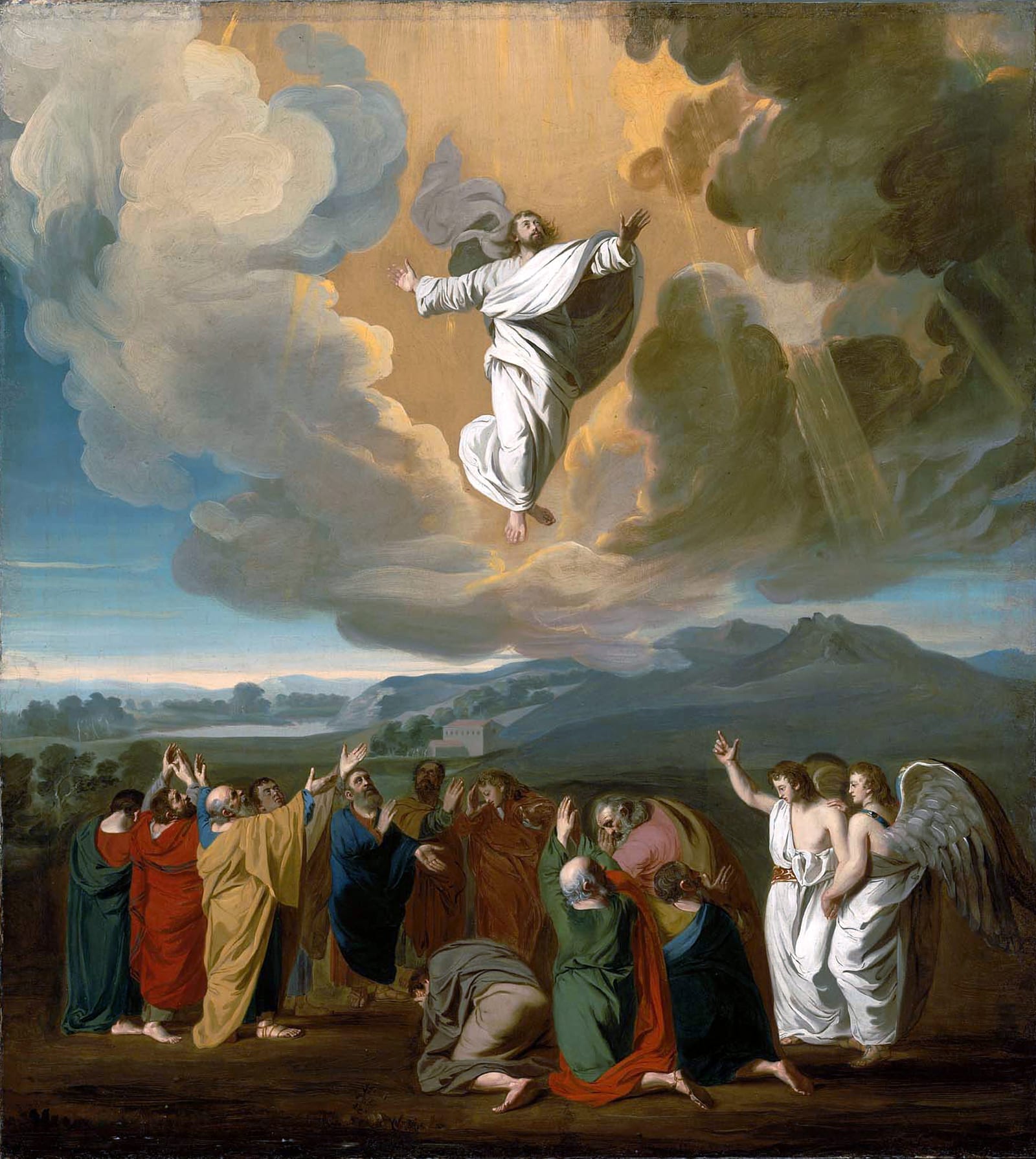
He ascended on high; the Son of Man brought on the clouds to the Ancient of Days

Psalm 68's 'thou hast ascended on high' and Daniel's Son of Man coming with the clouds to receive an everlasting kingdom are heaven's side of the Ascension, when a cloud received him out of the apostles' sight; the liturgy adds 'lift up your heads, O gates, that the King of Glory may enter' and 'God is gone up with a shout.'

Psalms 24 and 47 are liturgical and patristic (Justin, Irenaeus) applications used at the Ascension Mass, not quoted in the NT.

Seated at the right hand of God until his enemies are made his footstool

'The LORD said to my Lord: Sit at my right hand' — the Old Testament verse most quoted in the New — was claimed by Jesus before Caiaphas and proclaimed by Peter at Pentecost of the exalted Christ, who now sits at the Father's right hand interceding until every enemy is subdued.

All things put under his feet

Psalm 8's son of man, crowned with glory and honour with everything under his feet, is fulfilled in the risen Jesus, exalted above every power and made head over all things for the Church — though 'not yet do we see all things subject to him.'

Fulfilled in Christ's exaltation; the visible subjection of all things is awaited (Heb 2:8; 1 Cor 15:24-28).

An eternal throne, anointed above his fellows, worshipped by the angels

Hebrews 1 strings together the psalms of the Son's enthronement: 'Thy throne, O God, is for ever', 'God hath anointed thee above thy fellows', 'Thou remainest... thy years shall not fail', and 'let all the angels of God worship him' — all fulfilled when the Father brought the risen Firstborn into his heavenly glory.

'Let all God's angels worship him' is the Septuagint/Dead Sea Scrolls form of Deuteronomy 32:43, absent from the Masoretic text.

A priest for ever, ministering in the heavenly sanctuary and ever living to intercede

The oath 'Thou art a priest for ever according to the order of Melchizedek', Zechariah's Branch who is 'a priest upon his throne', and the Servant who 'made intercession for the transgressors' are fulfilled in Christ, who after his ascension exercises an unending priesthood at the Father's right hand.

The catalogue's 'Priest Forever' entry covers the Melchizedek oath at the Last Supper; this row is its heavenly continuation.

Every knee shall bow and every tongue confess

God swore through Isaiah that 'every knee shall bow to me, every tongue shall swear'; Paul applies the oath to the exalted Jesus, given the name above every name.

Fulfilled in Christ's exaltation and the Church's confession; the universal acknowledgement is awaited at the judgment (Rom 14:10-11).

The key of the house of David laid on his shoulder

The oracle to Eliakim — 'the key of the house of David I will lay upon his shoulder; he shall open and none shall shut' — is claimed in Revelation by the risen Christ, who holds the keys of death and of the kingdom he entrusts to Peter.

Lesser-known; the royal-steward office of Isaiah 22 is the background of the keys given to Peter.

The Spirit poured out on all flesh

Joel promised that afterward God would pour out his Spirit on all flesh, sons and daughters prophesying, and that whoever calls on the name of the Lord would be saved; Peter declared at Pentecost, 'This is that which was spoken by the prophet Joel.'

Joel 2:28-32 is numbered 3:1-5 in Catholic (NABRE) and Hebrew Bibles.

A new covenant, with the law written on hearts and all taught by God

Jeremiah foretold a new covenant unlike Sinai's, God's law written on the heart, sins remembered no more, all knowing the Lord 'from the least to the greatest'; Jesus named the chalice 'the new covenant in my blood', and Hebrews quotes Jeremiah in full as fulfilled.

The catalogue's Passion movement maps the Cenacle institution; this row follows the covenant's interior fulfilment by the Spirit.

Speaking to the people with other tongues — Babel reversed

Isaiah's 'with stammering lips and another tongue will he speak to this people' is cited by Paul as the scriptural basis of the gift of tongues, and Zephaniah's 'pure lip' given to the peoples, that all may call on the Lord's name together, was read by the Fathers in the Pentecost crowd hearing one gospel in every language.

Lesser-known; Zephaniah 3:9 is a patristic (not NT-quoted) application.

An everlasting covenant of peace, and God's dwelling set among his people for ever

Ezekiel, Jeremiah, and Isaiah promised 'an everlasting covenant... my tabernacle shall be with them', the 'sure mercies of David'; Paul reads 'I will dwell in them' of the Church as God's temple, Hebrews names 'the blood of the everlasting covenant', and Acts applies Isaiah 55:3 to the resurrection.

'My tabernacle shall be with them' (Ezek 37:27) awaits its consummation in Revelation 21:3.

The Root of Jesse, an ensign to which the Gentiles seek

Isaiah saw the Root of Jesse standing as a banner for the peoples, the nations seeking him and the scattered gathered from the four corners of the earth; Paul closes his catena on Gentile salvation with the verse, and Jesus 'lifted up' draws all to himself.

A light to the Gentiles, salvation to the ends of the earth

The Servant was appointed 'a covenant of the people, a light of the Gentiles' so that 'all the ends of the earth shall see the salvation of our God'; Simeon sang it over the infant, and Paul and Barnabas invoked it when they turned to the Gentiles.

The catalogue's Ministry movement maps Isaiah 42/49 at Galilee; this row follows the same text to the Gentile mission.

Nations come to his light, and kings bring their gifts

Isaiah's 'the Gentiles shall walk in thy light, and kings in the brightness of thy rising' and the psalmists' kings of Tarshish and Sheba bringing gifts were inaugurated by the Magi and are consummated when the kings of the earth bring their glory into the new Jerusalem.

Inaugurated at the Epiphany; the full homage of the nations is awaited.

A pure offering in every place among the nations — the sacrifice of the Mass

Malachi foretold that God would reject the Temple's offerings and instead receive 'in every place' a pure oblation from the rising of the sun to its setting; from the Didache to the Council of Trent the Church has read this of the Eucharist, the one sacrifice of Christ offered on every altar.

Didache 14 (c. AD 70) and Trent, Session XXII ch. 1, cite Mal 1:11 of the Mass; the Hebrew minhah ('offering') is read by many Catholic exegetes as an unbloody sacrifice. Paul's 'table of the Lord' (1 Cor 10:21) echoes Mal 1:7, 12.

The fallen tabernacle of David rebuilt, that the Gentiles may seek the Lord

Amos promised God would raise up the fallen tent of David 'that the residue of men may seek the Lord, and all the Gentiles upon whom my name is called'; James cited it at the Council of Jerusalem to justify receiving Gentiles without circumcision.

ForetoldAmos 9:11-12
FulfilledActs 15:15-18

James quotes the Septuagint form ('the residue of men'); the Hebrew reads 'the remnant of Edom'.

'Not my people' called 'my people'; Gentiles rejoice with his people

Hosea's reversal — 'where it was said, You are not my people, they shall be called sons of the living God' — together with Moses' 'I will provoke you to jealousy by a no-people... rejoice, O Gentiles, with his people' and Isaiah's 'I was found by them that sought me not', are applied by Paul and Peter to the calling of the Gentiles into the Church.

Hosea 1:10 is numbered 2:1 in Catholic and Hebrew Bibles.

One flock and one shepherd; a house of prayer for all nations

Isaiah foresaw foreigners joined to the Lord in 'a house of prayer for all peoples' and 'others gathered besides those already gathered', and Ezekiel one shepherd over a single flock; Jesus cleansed the Temple with the words and declared, 'Other sheep I have... there shall be one fold and one shepherd.'

Priests and Levites taken from among the Gentiles

Isaiah's closing oracle gathers 'all nations and tongues', sends survivors to the far coastlands to declare God's glory, and ends 'I will take of them for priests and Levites'; Paul calls his Gentile ministry a priestly service and Peter names the baptized 'a royal priesthood.'

Lesser-known; one of the few OT texts promising a priesthood drawn from the nations.

A kingdom that shall never be destroyed — 'of his kingdom there shall be no end'

Daniel's kingdom set up by the God of heaven that 'shall stand for ever', Isaiah's throne of David established 'from henceforth and for ever', and Nathan's oracle to David are echoed word for word by Gabriel to Mary: 'of his kingdom there shall be no end.'

Hebrews 12:26-28 reads Haggai's 'once more I will shake' as the removal of the shakeable so that the unshakable kingdom remains.

The stone cut out without hands that fills the whole earth

In Nebuchadnezzar's dream a stone 'cut out of the mountain without hands' shattered the kingdoms and grew into a mountain filling the earth; Jesus alluded to it ('on whomsoever it shall fall, it will grind him to powder'), and the mustard seed and leaven describe the same growth of the kingdom he founded.

The Fathers read 'without hands' of the virgin birth and the kingdom's growth without human power. Matthew 21:44 is absent from some manuscripts.

The mountain of the Lord's house raised above the hills — the Church, the Jerusalem above

Isaiah and Micah saw the mountain of the Lord's house exalted, all nations streaming to it, and the word going forth from Jerusalem; the gospel went out 'beginning at Jerusalem', Hebrews tells Christians 'you are come to Mount Zion', and Paul names the barren woman's many children the Church, 'the Jerusalem above, our mother.'

Psalm 87's 'this one was born there' — Gentiles enrolled as natives of Zion — is a patristic application.

The saints of the Most High receive and possess the kingdom

Daniel saw judgment given to the saints of the Most High and the kingdom under the whole heaven handed to them; Jesus gave his 'little flock' a kingdom, promised his apostles thrones, and Paul reminds the Church that 'the saints shall judge the world.'

Inaugurated in the Church; the saints' reign is consummated only at the end.

A feast on the mountain for all peoples

On 'this mountain' Isaiah saw the Lord of hosts make a feast of rich food and fine wine for all peoples, and there swallow up death; Jesus promised that many would come from east and west to recline with Abraham, and Revelation calls the consummation the marriage supper of the Lamb.

Inaugurated in the Eucharist; the marriage supper is awaited.

New heavens and a new earth; the new Jerusalem with jewelled foundations, no sun, and a river of life

Isaiah's new heavens and new earth, a Jerusalem of sapphire foundations whose gates never shut and whose light is the Lord, Ezekiel's river from the sanctuary with ever-fruiting trees, and Zechariah's living waters from Jerusalem are gathered in John's vision of the holy city coming down from God.

Awaited — not yet fulfilled (the living water is given now in the Spirit, John 7:39; the city and river are the consummation).

After the Messiah is cut off, the city and sanctuary destroyed

Daniel foretold that after the Anointed One is cut off 'the people of the prince that shall come shall destroy the city and the sanctuary', and Micah that Zion would be ploughed as a field; Jesus wept over the city and said not one stone would be left on another, fulfilled by Titus in AD 70.

Fulfilled AD 70. Catholic commentators allow the Olivet discourse a double reference — the fall of Jerusalem and, beyond it, the Second Coming.

Israel many days without king, prince, or sacrifice — and afterward to return

Hosea foretold that Israel would abide 'many days without king, without prince, without sacrifice', and afterward return to seek the Lord and David their king; the Temple sacrifices ceased in AD 70, Jerusalem was 'trodden down by the Gentiles', and Paul awaits the day when 'all Israel shall be saved.'

The cessation of sacrifice is fulfilled (AD 70); Israel's return (Hos 3:5; Rom 11:26) is awaited — not yet fulfilled.

The Son of Man coming on the clouds, every eye seeing him, his feet on the Mount of Olives, with all his saints

Daniel's Son of Man coming with the clouds, Zechariah's 'they shall look on him whom they pierced' and 'his feet shall stand on the Mount of Olives... and all the saints with him', and 'the Lord shall be king over all the earth' describe the Second Coming which the angels promised would mirror the Ascension from that same hill.

Awaited — not yet fulfilled. Daniel 7:13 was fulfilled first in the Ascension (heaven's side); its public coming on the clouds remains future.

He comes to judge the world in righteousness — the judge of the living and the dead

The psalms sang that the Lord 'cometh to judge the earth... the world with righteousness', Daniel saw the court seated and the books opened, and Isaiah's Branch judges the poor with equity and slays the wicked with the breath of his lips; Paul at Athens quoted the psalm of the Man God appointed, proved by raising him from the dead.

Awaited — not yet fulfilled (the Judge is appointed and the judgment begun in his word, John 5:22-27; the Last Judgment remains future). Joel 3 is numbered chapter 4 in Catholic (NABRE) Bibles.

The Day of the Lord: the sun darkened, the stars fall, the heavens rolled up, the wicked as stubble in the furnace

Joel, Isaiah, Zephaniah, and Malachi describe the great and terrible Day — sun turned to darkness, stars falling like leaves, a furnace for the proud, a worm that dies not — which Jesus and the apostles place at his revelation from heaven in flaming fire.

Awaited — not yet fulfilled. Malachi 4:1-3 is numbered 3:19-21 in Catholic (NABRE) and Hebrew Bibles.

'You shall not see me until you say: Blessed is he that cometh in the name of the Lord'

The Hallel's 'Blessed is he that cometh in the name of the Lord', sung on Palm Sunday, was turned by Jesus into a prophecy of his return: Jerusalem will not see him again until it greets him with that acclamation.

Awaited — not yet fulfilled. Lesser-known; the psalm's first fulfilment is the triumphal entry (Passion movement).