
Behold this Heart which has so loved men — and the Nine First Fridays
The devotion to the physical Heart of Christ as the sign of His love: given its modern form through St. Margaret Mary Alacoque at Paray-le-Monial between 1673 and 1675, carrying the Twelve Promises, the Nine First Fridays, the June feast, and four papal encyclicals across three centuries.
Older than Paray
The devotion did not begin in 1673. It begins at the Cross, where the soldier's lance opened the side of Christ and 'immediately there came out blood and water' (John 19:34) — the wound the Fathers read as the birth of the Church. It runs through St. Bernard, St. Gertrude the Great, who in the thirteenth century rested her head where St. John had rested his and was told the Heart's sweetness was being kept for a colder age, and St. John Eudes, who was composing a Mass and Office of the Sacred Heart in France before Margaret Mary ever entered religion.
What Paray-le-Monial added was not the idea but the commission: a definite request, with a feast attached, a form of reparation, and a promise — and a nun ordered to make it public.
Margaret Mary and the Great Apparition
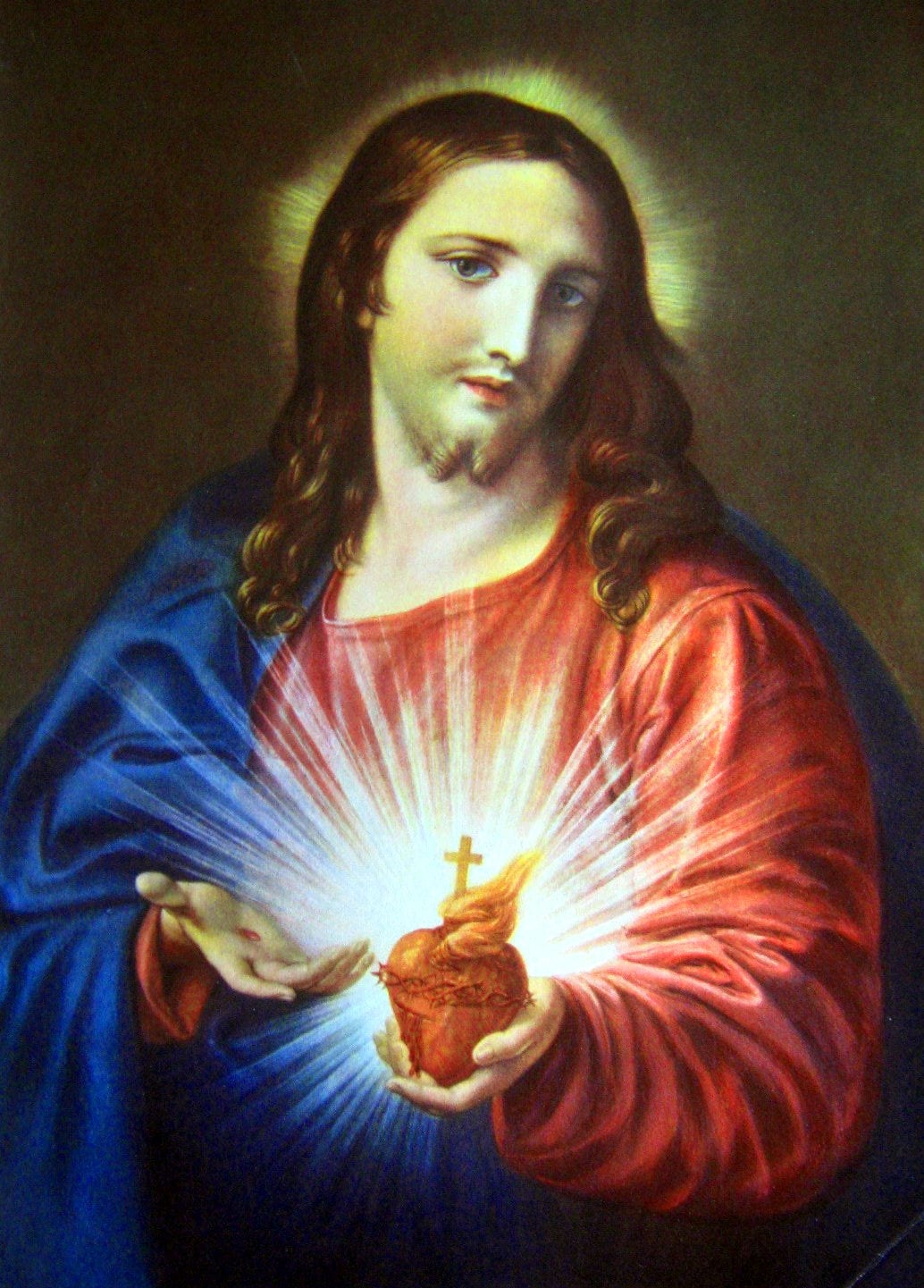
Margaret Mary Alacoque entered the Visitation convent at Paray-le-Monial in 1671. Between December 1673 and June 1675 she received a series of apparitions of Christ showing His Heart — encircled with thorns, surmounted by a cross, burning.
In the last of them, during the octave of Corpus Christi in June 1675 — the one tradition calls the Great Apparition — she recorded the words that have been carved on a thousand church walls since: 'Behold this Heart which has so loved men that it has spared nothing, even to exhausting and consuming itself, in order to testify to them its love; and in return I receive from the greater number nothing but ingratitude.' He asked for a feast on the Friday after the octave of Corpus Christi, for Communion in reparation, and for the Holy Hour on Thursday nights.
She was not believed. Her community judged her deluded, and the request went nowhere until the arrival of a Jesuit, St. Claude de la Colombière, who examined her, believed her, and became — as she had been told he would be — the devotion's first apostle. He died in 1682; she in 1690; and the feast she had asked for reached the universal Church one hundred and eighty-one years after the Great Apparition.
What the Church teaches the devotion is
Pius XII wrote <em>Haurietis Aquas</em> in 1956 in part to correct a sentimental reading of the devotion, and it remains the clearest statement of what is actually being venerated. The object is the physical Heart of Jesus — a real human heart, hypostatically united to the Word — venerated as the natural sign and symbol of His threefold love: the divine love He shares with the Father and the Spirit, the burning spiritual love of His human soul, and the sensible love of His human affections.
That is why the devotion is not optional sentiment dressed as theology. It is the Incarnation looked at from the inside: God has a human heart, and it can be broken.
The Promises
The Twelve Promises are the best-known list in Catholic devotional life, and the least well understood. They were not delivered as a numbered set: they were gathered from Margaret Mary's letters and writings and arranged into twelve by later editors — and the twelfth, the Great Promise, needs reading with real care.
"I will give them all the graces necessary in their state of life; I will establish peace in their homes; I will console them in all their afflictions; I will be their refuge in life and especially in death."
The list as printed on holy cards is a compilation made after the saint's death from her letters and accounts, not a single dictated text. Its substance is nonetheless what the Church has commended for three centuries, and every promise in it is a promise of grace within the ordinary Christian life, not a shortcut around it.
"The Great Promise: to those who receive Holy Communion on nine consecutive First Fridays, the grace of final penitence — they shall not die in His displeasure, nor without receiving the sacraments, His Heart becoming their assured refuge at that last hour."
This is the promise most often misused and most worth stating precisely. It is not a guarantee of salvation regardless of how one lives, and it was never taught as one — read that way it would contradict the Council of Trent, which teaches that no one can know with the certainty of faith that he is in the state of grace. What is promised is the grace of final repentance: that the Heart of Christ will obtain for such a soul, at the end, the contrition and the sacraments it needs. And consider what the practice itself does — nine months of confession and Communion on a fixed day, made deliberately and in reparation. A person who completes it has spent nine months being converted. The promise and the practice are not two things.
"I will bless every place in which an image of my Heart shall be exposed and honoured."
The ground of the Enthronement of the Sacred Heart in Catholic homes, promoted from 1907 by Fr. Mateo Crawley-Boevey with the encouragement of St. Pius X. The image is a sacramental: it disposes the household to grace, and it is honoured by the life lived under it.
Living the Devotion
- 1.The Nine First Fridays: Holy Communion on the first Friday of nine consecutive months, with sacramental confession as needed and the intention of making reparation.
- 2.The Holy Hour, traditionally on Thursday night, keeping watch in the garden with Christ.
- 3.The June devotions — the whole month is dedicated to the Sacred Heart, with the feast on the Friday after the octave of Corpus Christi.
- 4.Enthronement of an image of the Sacred Heart in the home, with the family's act of consecration.
- 5.The Morning Offering, which places the whole day's work and suffering into the Heart of Christ before it begins.
In the Words of the Popes
"In that Sacred Heart all our hopes should be placed, and from it the salvation of men is to be confidently sought."
"The Heart of the Incarnate Word is rightly considered the chief sign and symbol of that threefold love with which the divine Redeemer continuously loves the eternal Father and all mankind."
"In this Heart, we finally recognize ourselves, and we learn to love. Everything comes together in the Heart of Christ."