
When the course of her earthly life was finished, Mary was taken up body and soul into the glory of heaven — the only dogma defined by a pope under the conditions of Vatican I's teaching on infallibility.
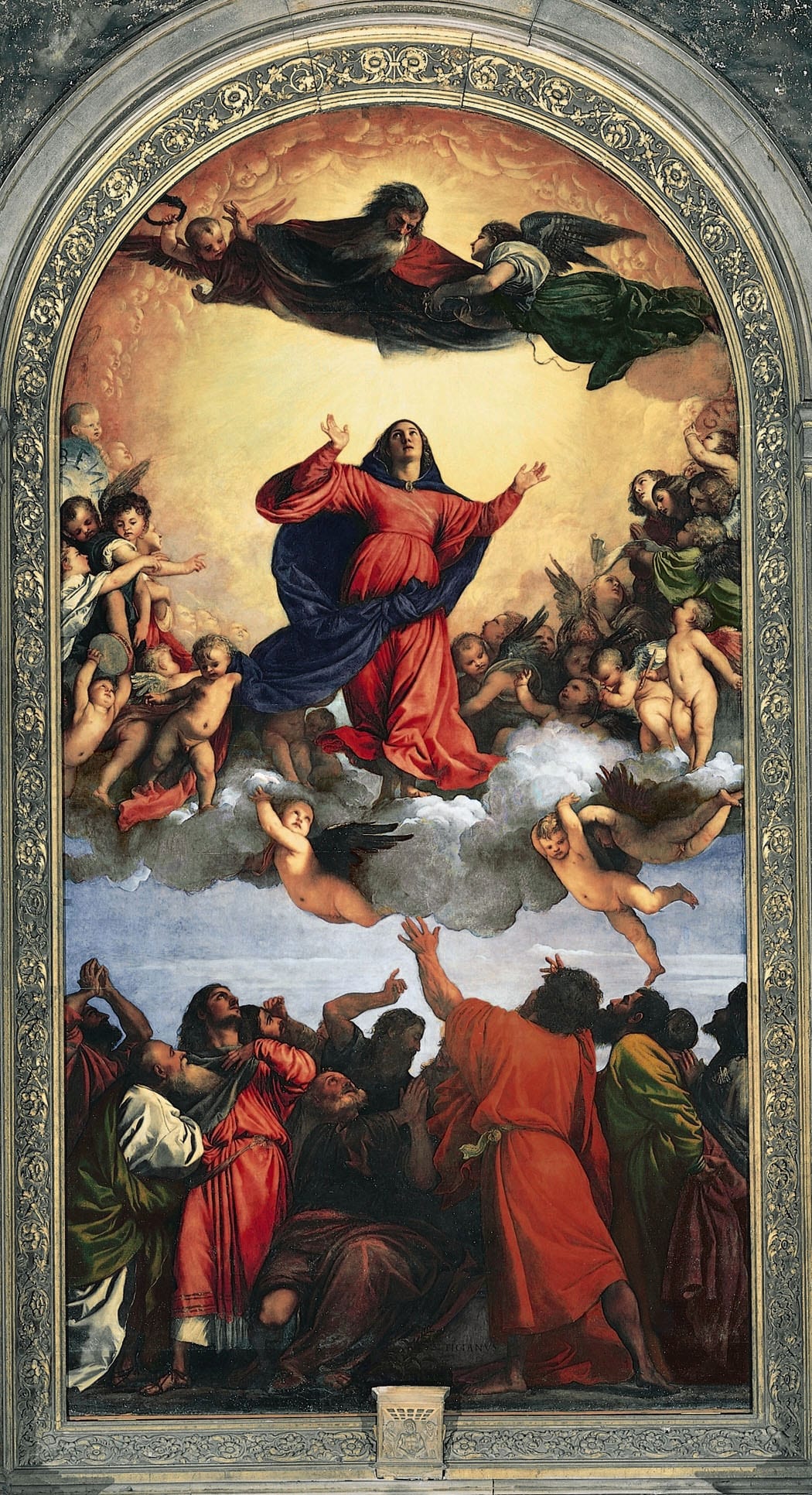
“We pronounce, declare, and define it to be a divinely revealed dogma: that the Immaculate Mother of God, the ever Virgin Mary, having completed the course of her earthly life, was assumed body and soul into heavenly glory.”
Solemnly defined by an ecumenical council or by a pope teaching ex cathedra. The wording of the definition itself is what binds, and it cannot be reversed.
The Scripture it rests on
“And a great sign appeared in heaven: A woman clothed with the sun, and the moon under her feet, and on her head a crown of twelve stars.”
Apocalypse 12:1 →“And the temple of God was opened in heaven: and the ark of his testament was seen in his temple.”
Apocalypse 11:19 →“Arise, O Lord, into thy resting place: thou and the ark, which thou hast sanctified.”
Psalms 131:8 →“Because he hath regarded the humility of his handmaid: for behold from henceforth all generations shall call me blessed.”
Luke 1:48 →The relic that was never claimed
The strongest historical argument for the Assumption is an absence. The early Church collected relics with great seriousness and competed for them: cities built basilicas over the bones of apostles, and the burial places of the martyrs were known and venerated within living memory. Yet no city has ever claimed the body of the Mother of God. Jerusalem and Ephesus both preserve traditions of where she departed this life; neither has ever claimed to have her.
The feast is kept from at least the sixth century in the East as the Dormition — the Falling Asleep — and in Rome from the seventh. When Pius XII consulted the world's bishops in 1946, the response was as near unanimous as such a canvass has ever been.
How Pius XII asked, and what the liturgy had been saying
He did not define first and consult afterwards. On 1 May 1946, in the letter Deiparae Virginis Mariae, he put a question to every bishop in the world: “Do you judge that the bodily Assumption of the Blessed Virgin can be proposed and defined as a dogma of faith?” — and a second, whether they and their people desired it. The constitution records that the bishops “gave an almost unanimous affirmative response to both these questions.”
The case he then made was largely from prayer. “Since ancient times,” he wrote, “there have been both in the East and in the West solemn liturgical offices commemorating this privilege.” The sacramentary of Pope Adrian I, in the eighth century, already prayed that “the holy Mother of God suffered temporal death, but still could not be kept down by the bonds of death.” St. John Damascene, preaching in the same century, put the logic of the whole tradition into a sentence: “It was fitting that she, who had kept her virginity intact in childbirth, should keep her own body free from all corruption even after death.”
Then the sanction, in the form Vatican I had made possible eighty years before: “If anyone … should dare willfully to deny or to call into doubt that which we have defined, let him know that he has fallen away completely from the divine and Catholic Faith.” It is the only time a pope has defined a dogma by that machinery, and this is what he used it for.
The one deliberate silence
The definition contains a careful gap. It says “having completed the course of her earthly life” — and does not say whether she died. The Eastern tradition of the Dormition holds that she did, and so does the very sacramentary Pius XII quoted; a strand of Western opinion holds that she was assumed without dying. Pius XII declined to settle it, and the dogma leaves the question open to this day.
It is a good illustration of how narrowly the Church defines: she defines what has been revealed and stops, rather than tidying up the loose ends.
What it does not mean
A great deal of what people believe the Church teaches, and reject, is something she has never taught.
The Assumption is the same as the Ascension.
Christ ascended by His own power; Mary was assumed — taken up — by God's. One is an act, the other a gift received.
It teaches that Mary did not die.
It deliberately does not say. The definition's phrase, “having completed the course of her earthly life”, was chosen to leave the question open.
The Assumption was invented in 1950.
It was defined in 1950. Pius XII's own argument was that it had been prayed for a thousand years — a feast in the East from at least the sixth century, in Rome from the seventh, a prayer in Adrian I's sacramentary in the eighth — and he asked the bishops of the whole world before he wrote a word. What 1950 added was certainty, not content.
Why it matters
- ☾It is the dogma of the body's dignity: a human body is already in glory, and it is not Christ's alone.
- ☾It is a promise shown rather than described — what the Church means by the resurrection of the body has one worked example.
- ☾It was defined in 1950, five years after the world had seen what could be done to human bodies at Auschwitz and Hiroshima. Pius XII said as much: he defined it against an age that had learned to treat flesh as disposable.