
In the Blessed Sacrament the whole substance of the bread is changed into the substance of Christ's Body and the whole substance of the wine into His Blood — Body, Blood, Soul, and Divinity — the appearances of bread and wine alone remaining.
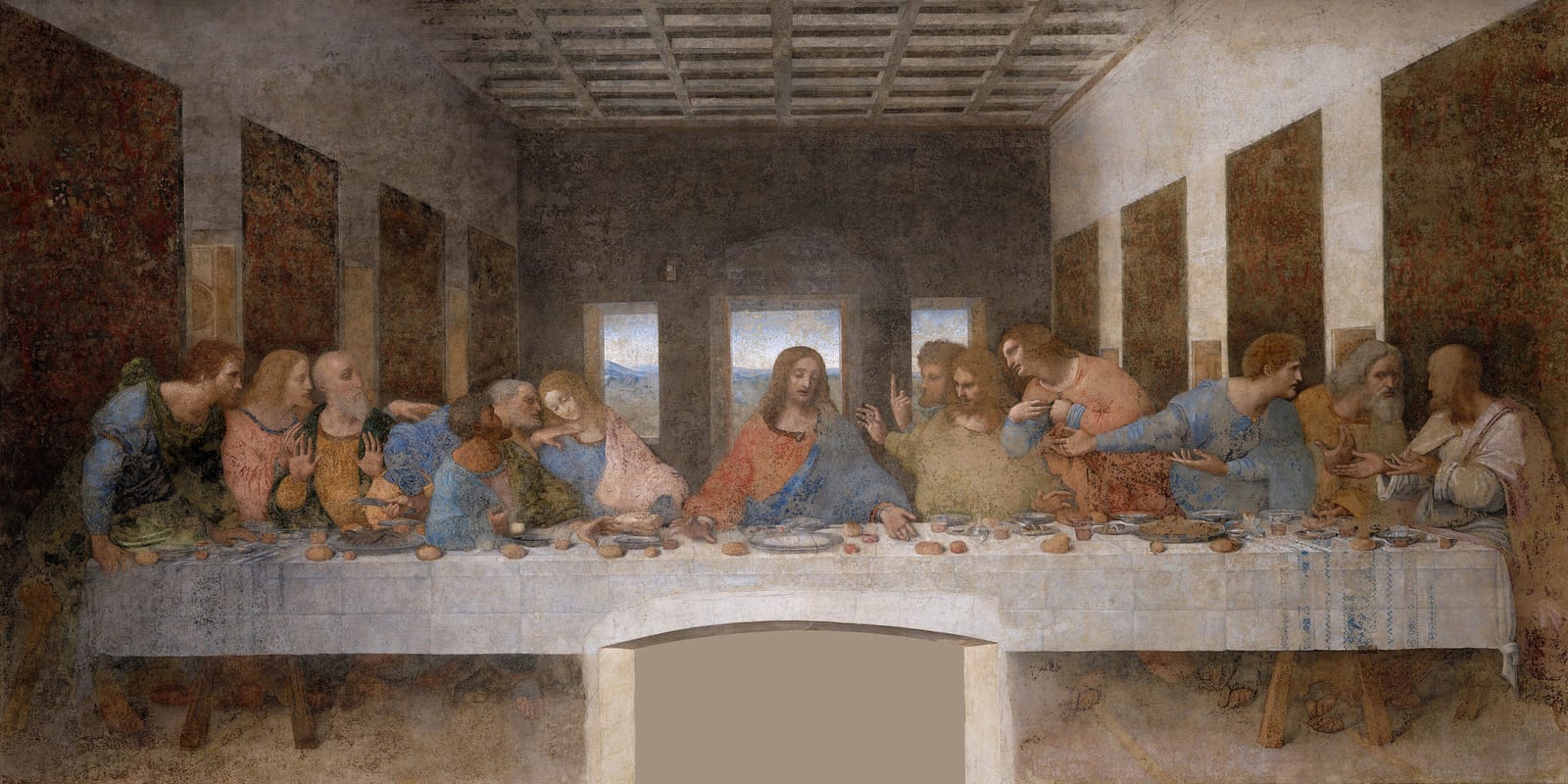
“By the consecration of the bread and of the wine, a conversion is made of the whole substance of the bread into the substance of the body of Christ our Lord, and of the whole substance of the wine into the substance of His blood; which conversion is, by the holy Catholic Church, suitably and properly called Transubstantiation.”
Solemnly defined by an ecumenical council or by a pope teaching ex cathedra. The wording of the definition itself is what binds, and it cannot be reversed.
The Scripture it rests on
“Take ye, and eat. This is my body.”
Matthew 26:26 →“For my flesh is meat indeed: and my blood is drink indeed.”
John 6:55 →“For he that eateth and drinketh unworthily, eateth and drinketh judgment to himself, not discerning the body of the Lord.”
1 Corinthians 11:29 →The word arrives late; the belief does not
'Transubstantiation' first appears in a conciliar text at the Fourth Lateran Council in 1215 and receives its full definition at Trent in 1551. The belief it describes is very much older. St. Ignatius of Antioch, writing about AD 107 on his way to be killed, complains of heretics who 'abstain from the Eucharist because they do not confess that the Eucharist is the flesh of our Saviour Jesus Christ.' St. Justin Martyr around 150 tells a pagan emperor that Christians do not receive this food as common bread and common drink.
The pattern is the usual one: the Church says a thing simply for centuries, someone denies it, and she is forced to say it precisely. The precision at Trent came after the Reformation had produced a range of alternatives — symbol, spiritual presence, presence only in the moment of reception — and it was framed to exclude all of them.
What the word is doing
The distinction Trent uses — substance and accidents — is often mistaken for a piece of medieval physics that modern chemistry has disproved. It is not making a chemical claim. Accidents means everything you can observe or measure: colour, taste, weight, chemical composition. Substance means what a thing most fundamentally is. Trent teaches that everything measurable stays exactly as it was, and what the thing is has changed.
This is why the doctrine is not disproved by putting a consecrated host under a microscope, and also why the Eucharistic miracles catalogued on this site are so striking: in a handful of cases the accidents themselves have changed too — flesh and blood visible to the eye and, at Lanciano, to a pathology laboratory. The Church does not need those events, and she has never made faith depend on them. But they are what happens when the veil slips.
What it does not mean
A great deal of what people believe the Church teaches, and reject, is something she has never taught.
It is a symbol of Christ, a powerful reminder.
Trent's canons say the opposite in as many words, and anathematize the position. Symbol is precisely what it is not.
The bread and wine become a corpse and blood in some cannibalistic sense.
What is present is the living, glorified Christ, whole and entire — Body, Blood, Soul, and Divinity — not a body divided or a Christ diminished. He is not consumed; the communicant is.
You get more of Christ from the host than from the chalice, or from a large host than a small one.
The whole Christ is present under either species and in every part of either. A fragment is not a fragment of Him.
Why it matters
- ☩It is why Catholics genuflect, why the tabernacle has a lamp, and why a church is never merely a hall.
- ☩It is why the Church takes reception seriously — Communion is not a gesture of belonging but the reception of a Person.
- ☩It means the nearest you will come to Christ in this life is not a feeling or an insight, and it happens at a specific time on a specific street.