
There is one God, and in the one God three distinct Persons — Father, Son, and Holy Spirit — each fully God, of one and the same substance, yet really distinct from one another.
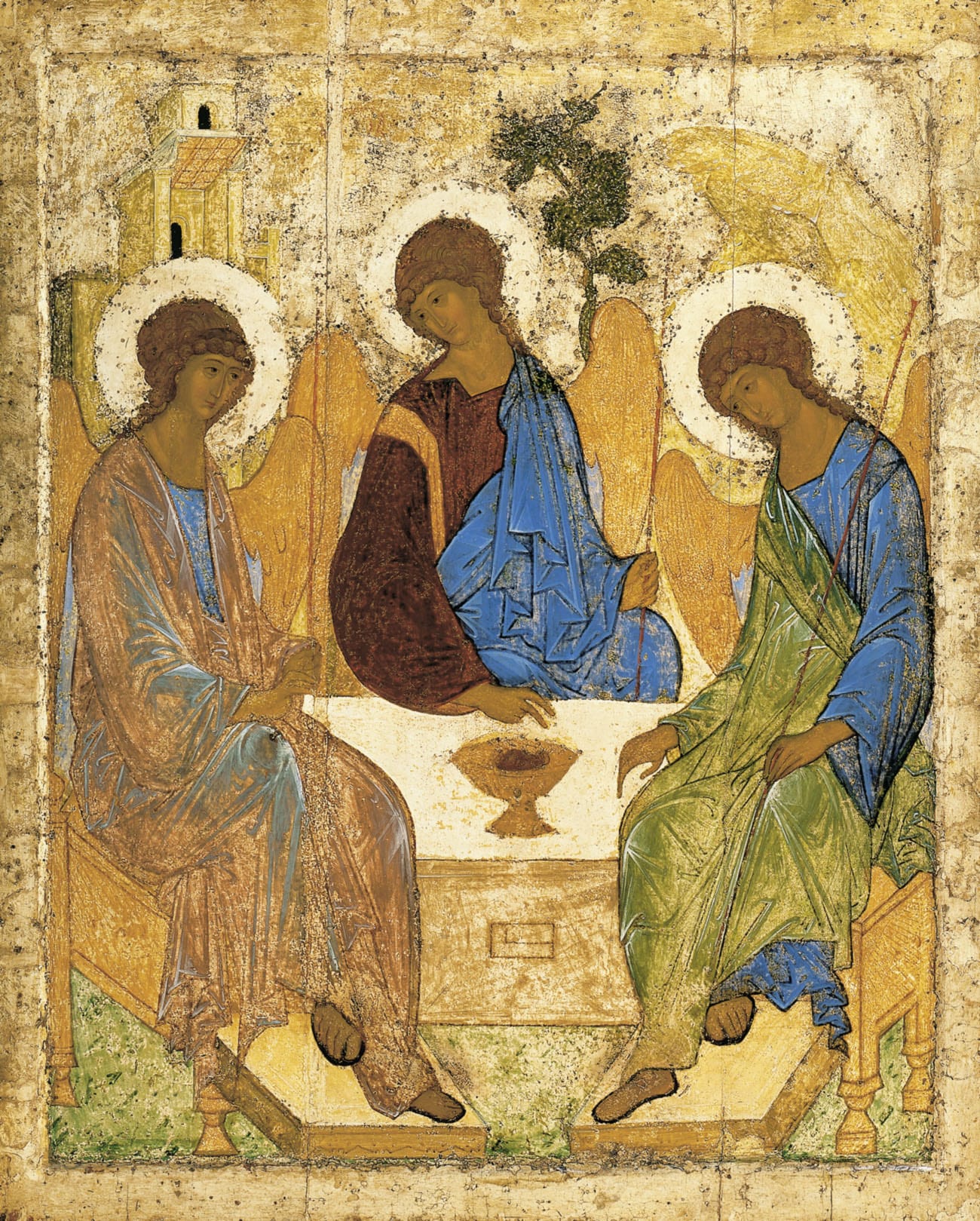
“We believe in one God, the Father almighty, maker of heaven and earth… and in one Lord Jesus Christ, the Only Begotten Son of God, born of the Father before all ages, God from God, Light from Light, true God from true God, begotten, not made, consubstantial with the Father… and in the Holy Spirit, the Lord, the giver of life, who proceeds from the Father and the Son, who with the Father and the Son is adored and glorified.”
Solemnly defined by an ecumenical council or by a pope teaching ex cathedra. The wording of the definition itself is what binds, and it cannot be reversed.
The Scripture it rests on
“Going therefore, teach ye all nations: baptizing them in the name of the Father, and of the Son, and of the Holy Ghost.”
Matthew 28:19 →“In the beginning was the Word, and the Word was with God, and the Word was God.”
John 1:1 →“And I will ask the Father, and he shall give you another Paraclete, that he may abide with you for ever.”
John 14:16 →“The grace of our Lord Jesus Christ, and the charity of God, and the communication of the Holy Ghost be with you all.”
2 Corinthians 13:13 →One word, and the whole faith hanging on it
Around the year 318 a priest of Alexandria named Arius began teaching that the Son, though the highest of all creatures and the agent of creation itself, was nonetheless a creature: there was, he said, a time when the Son was not. It was an attractive position. It kept God's oneness tidy, it made the Incarnation easier to picture, and it had the ring of common sense.
The Emperor Constantine, alarmed at an empire-wide quarrel, summoned the bishops to Nicaea in 325. What they produced turned on a single word that is not in Scripture at all: homoousios — consubstantial, of one substance with the Father. The Church has been accused ever since of importing philosophy into revelation. The answer is that the word was chosen precisely because it was the one word Arius could not sign. Every scriptural phrase had already been bent to fit his teaching; this one could not be.
Nicaea did not end it. Arianism grew stronger for fifty years after its condemnation, held most of the imperial court, and at one point most of the world's bishops. It was the long, stubborn work of St. Athanasius — exiled five times — and later the Cappadocian Fathers, St. Basil the Great and St. Gregory of Nazianzus, that carried the definition through to the Council of Constantinople in 381, where the article on the Holy Spirit was filled out into the Creed still said at Mass.
Why it cannot be explained, and should not be
The Trinity is not a puzzle awaiting a clever solution. It is what the Church calls a mystery in the strict sense: a truth that could never have been reasoned out, and that cannot be exhausted once revealed. Every analogy fails — the shamrock, the three states of water, the man who is father, son, and husband — and each fails in a way that has a heresy named after it.
St. Augustine spent thirty years writing De Trinitate and told the story on himself of walking on the shore and seeing a child pouring the sea into a hole in the sand. What the Church defined at Nicaea and Constantinople is not an explanation. It is a boundary: this much has been revealed, and thus far the mind may go and no further, and inside those walls there is room to adore.
What it does not mean
A great deal of what people believe the Church teaches, and reject, is something she has never taught.
Three gods.
One God. The Persons are not three parts, three portions, or three individuals sharing a nature the way three men share humanity. Each Person is wholly and entirely God, and there is one God.
One Person wearing three masks — God as Father in the Old Testament, Son in the Gospels, Spirit now.
This is modalism, condemned in the third century. The Persons are really distinct and simultaneous: the Son prays to the Father and the Spirit descends on Him at the Jordan, all at once.
The Father is older, or greater, or came first.
The Son is begotten of the Father before all ages, not created in time — 'begotten, not made'. There is order of origin within the Trinity, but no order of rank and no before.
Why it matters
- ☘It means God did not need to create anything in order to love. He is love in Himself, eternally, between the Persons — so creation is a gift and not a lack being filled.
- ☘It means prayer is not shouting at a distant power. The Spirit prays in us, to the Father, through the Son: you are praying inside God, not merely toward Him.
- ☘Every time you make the Sign of the Cross you are professing Nicaea. It cost fifty years and several exiles to be able to say it that easily.