
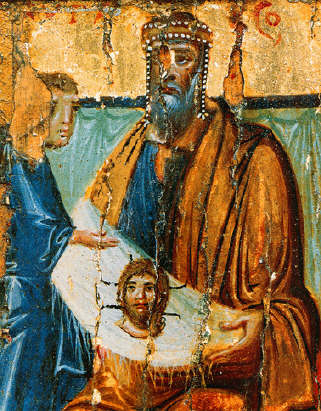
Eusebius of Caesarea, the great historian of the early Church, records in Book I, chapter 13 of his Ecclesiastical History (c. AD 325) that he himself, while in Edessa, examined the records preserved in the city's archives. There he found two letters in Syriac which had been kept since the time of the Apostles: a letter from King Abgar V of Osroene to Christ, written shortly before the Passion, and Christ's reply.
King Abgar (Ar. 'Abgar Ukkama' — 'Abgar the Black') ruled the small kingdom of Osroene from his capital at Edessa, on the upper Euphrates. He was suffering from a serious disease — by tradition, leprosy. Hearing reports of Christ's miracles in Judea, he wrote to Him: 'Abgar, ruler of Edessa, to Jesus the good Saviour, who hath appeared in the country of Jerusalem, greeting. I have heard the reports concerning Thee and Thy cures, that they are wrought by Thee without drugs or herbs... having heard all these things concerning Thee, I have concluded that Thou art one of two things: either Thou art God, and having descended from heaven Thou doest these things, or, doing these things, Thou art the Son of God. On this account, I have written to ask Thee to come to me, who entreat Thee, and to heal the disease which I have.'
Christ's reply, preserved verbatim by Eusebius: 'Blessed art thou who hast believed in me without having seen me. For it is written concerning me that those who have seen me will not believe in me, and that those who have not seen me will believe and be saved. But in regard to what thou hast written, that I should come to thee, it is necessary for me to fulfil all things here for which I have been sent, and after I have fulfilled them thus to be taken up again to Him that sent me. But after I have been taken up I will send to thee one of my disciples, that he may heal thy disease and give life to thee and thine.'
After the Ascension, the Apostle Thomas sent Thaddeus (Addai, traditionally one of the Seventy) to Edessa. He healed Abgar of his disease and converted the king and the city. Edessa became one of the first Christian kingdoms in history — and the Syriac liturgical tradition that took root there is one of the oldest continuously-celebrated liturgies in the world.
Closely associated with this correspondence is the Mandylion or Image of Edessa — a cloth bearing the miraculously imprinted face of Christ. According to the parallel tradition preserved in the Doctrine of Addai (a 4th-century Syriac text), Abgar's court painter Hannan was sent to bring back a likeness of Christ; unable to capture His face, he received from Christ a cloth on which Christ had pressed His own features. The Mandylion was venerated at Edessa for centuries, transferred to Constantinople in 944, lost to Western Crusaders in 1204, and is by one major scholarly hypothesis identical with the Shroud of Turin (the Mandylion being the folded image of the upper portion, the Shroud being the full unfolded burial cloth).
The Catholic Church has never formally pronounced on the authenticity of the Letter or the Mandylion. The Council of Rome under Pope Gelasius I (494) listed the Abgar Letter among the apocryphal writings; yet Eusebius's testimony stands, and the early Christian community at Edessa was certainly historical. The Letter has been a touchstone of Christian devotion for nearly seventeen hundred years, carried as an amulet, inscribed on the walls of homes in the medieval East, and quoted in the breviaries of the early Syriac, Armenian, and Coptic Churches.