
Jesus Christ is one divine Person in whom two complete natures, divine and human, are united without confusion, change, division, or separation — perfect God and perfect man, with a human body and a rational human soul.
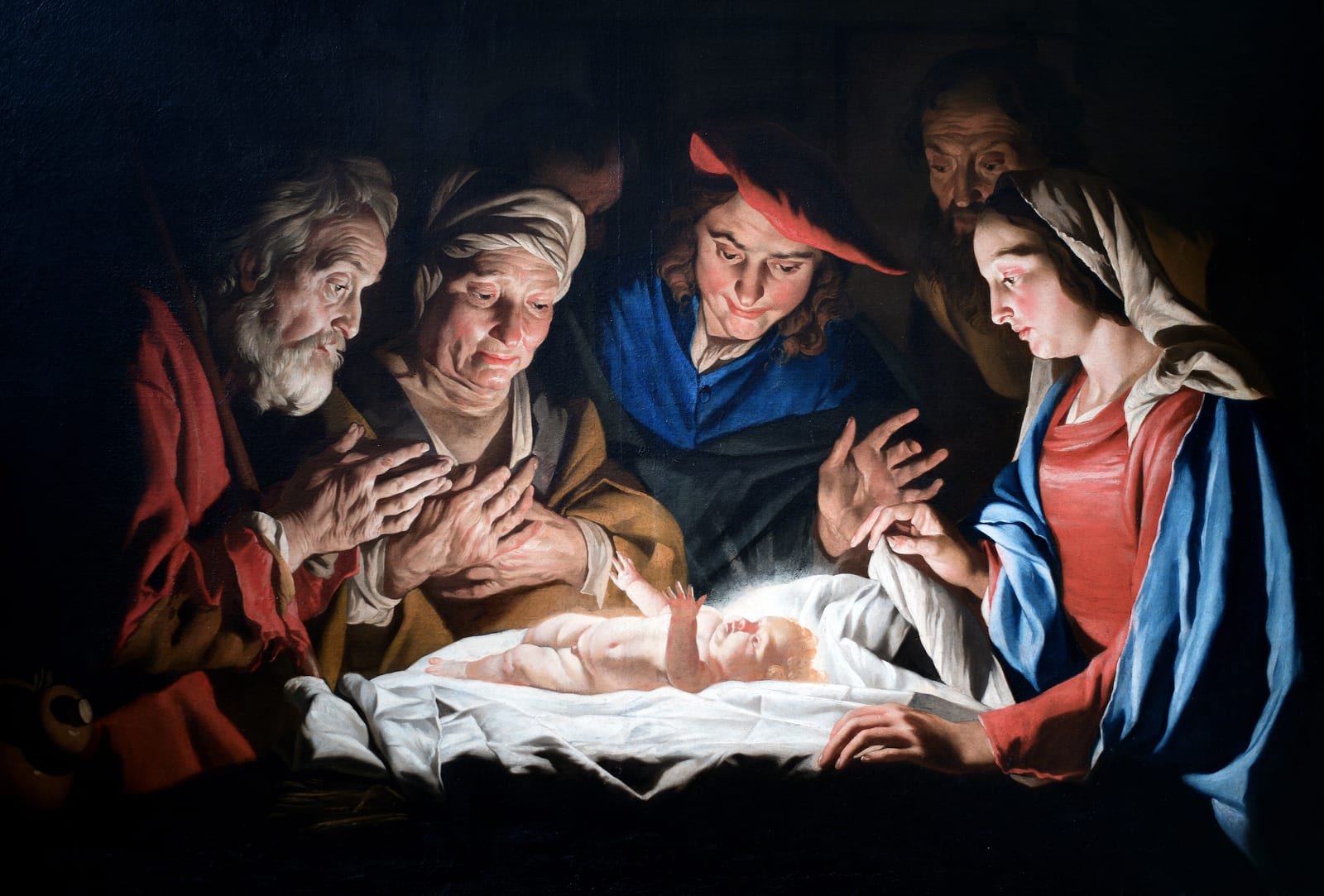
“We confess one and the same Christ, Son, Lord, Only-begotten, acknowledged in two natures without confusion, without change, without division, without separation — the difference of the natures being in no way destroyed by the union, but rather the property of each nature being preserved and coming together into one Person and one hypostasis.”
Solemnly defined by an ecumenical council or by a pope teaching ex cathedra. The wording of the definition itself is what binds, and it cannot be reversed.
The Scripture it rests on
“And the Word was made flesh, and dwelt among us, and we saw his glory, the glory as it were of the only begotten of the Father, full of grace and truth.”
John 1:14 →“Who being in the form of God, thought it not robbery to be equal with God: but emptied himself, taking the form of a servant, being made in the likeness of men.”
Philippians 2:6-7 →“For we have not a high priest, who can not have compassion on our infirmities: but one tempted in all things like as we are, without sin.”
Hebrews 4:15 →Four adverbs that took four centuries
The Chalcedonian definition reads like a legal instrument because it is one: every phrase in it closes a door that someone had walked through. Against Apollinaris, who taught that the divine Word replaced Christ's human mind, it insists on a rational human soul. Against Nestorius, who so divided the natures that Christ threatened to become two persons in partnership, it says without division, without separation. Against Eutyches, who let the human nature be swallowed up in the divine like a drop of honey in the sea, it says without confusion, without change.
The four adverbs are the fence around a mystery, and the fence has held for sixteen hundred years — not only in the Catholic Church but in nearly all of Christianity, which is why Chalcedon is the most widely accepted doctrinal statement ever written.
Why the Church would not simplify it
Every heresy about Christ is an attempt to make Him easier to think about, and every one of them costs something. If He is not fully God, then He cannot save; a creature cannot bridge the gap to the Creator. If He is not fully man, He has not touched what needs healing — as St. Gregory of Nazianzus put it, 'that which is not assumed is not healed.' And if He is two persons rather than one, then when the man Jesus died on the Cross, it was not God who died for us.
The definition is difficult because the alternative is not simpler faith but a smaller salvation.
What it does not mean
A great deal of what people believe the Church teaches, and reject, is something she has never taught.
Jesus is half God and half man.
He is fully both. Not a blend, not fifty per cent of each — perfect God and perfect man, whole in each nature.
Jesus is two people, or God wearing a human suit.
One Person — a divine Person — who possesses two natures. When you speak to Jesus you are speaking to the second Person of the Trinity, who has a human face.
Because He is God, His humanity was not real — He only appeared to hunger, to weep, to die.
That is Docetism, rejected from the first century. He was genuinely tired at the well, genuinely wept at the tomb, and genuinely died.
Why it matters
- ✝It means God knows what it is like from the inside — not by observation, but by having lived it.
- ✝It is why the Cross saves: because the One who died is a divine Person, His death has infinite worth.
- ✝It means the human body and human work are capable of holiness, since God did thirty years of them in a carpenter's shop before anyone noticed.