
From the first instant of her conception, by a singular grace and in view of the merits of Jesus Christ, Mary was preserved free from every stain of original sin. She was redeemed — more perfectly than anyone, by being kept from the fall rather than lifted out of it.
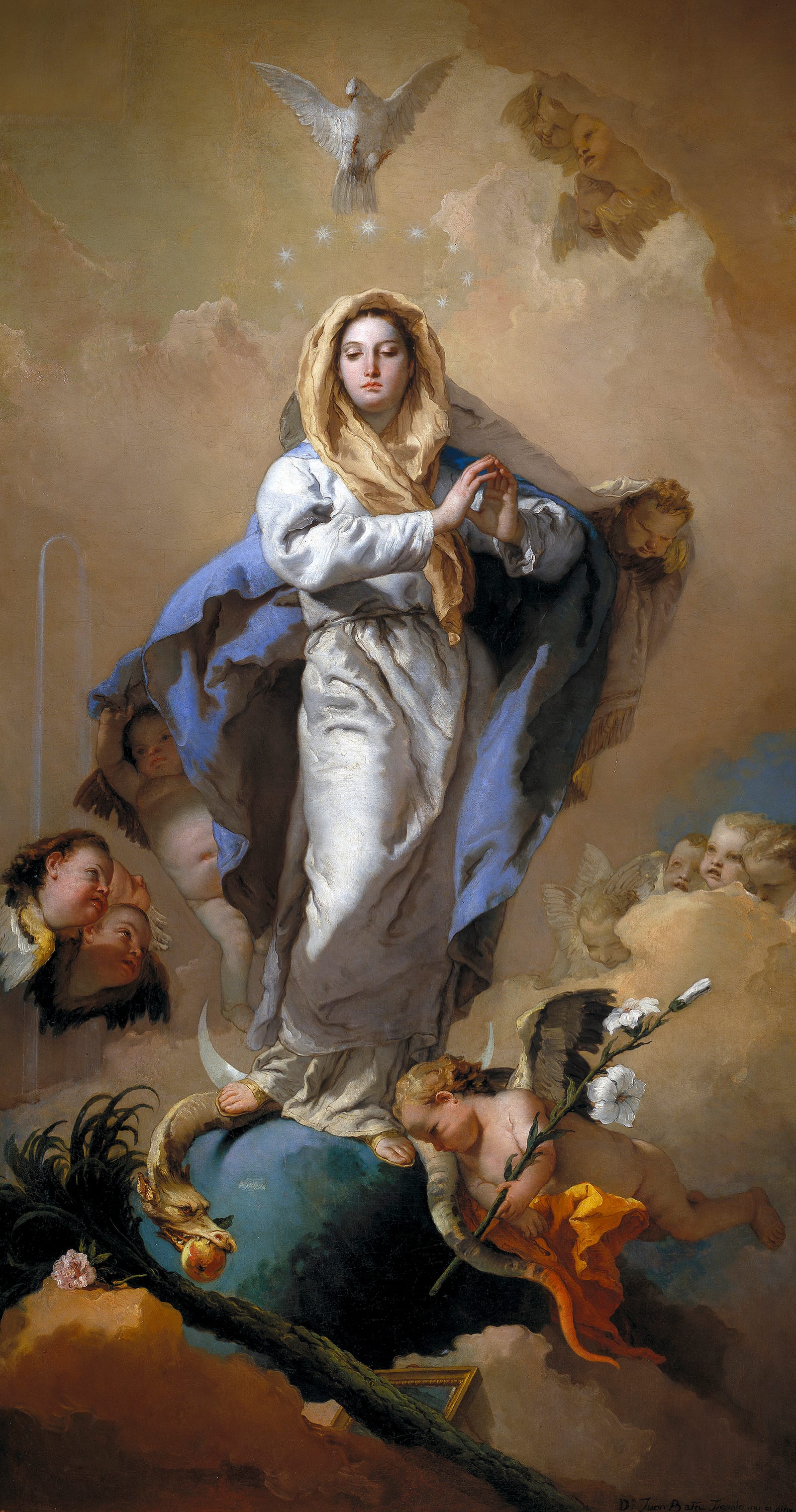
“The most Blessed Virgin Mary, in the first instant of her conception, by a singular grace and privilege granted by Almighty God, in view of the merits of Jesus Christ, the Saviour of the human race, was preserved free from all stain of original sin.”
Solemnly defined by an ecumenical council or by a pope teaching ex cathedra. The wording of the definition itself is what binds, and it cannot be reversed.
The Scripture it rests on
“Hail, full of grace, the Lord is with thee: blessed art thou among women.”
Luke 1:28 →“I will put enmities between thee and the woman, and thy seed and her seed: she shall crush thy head, and thou shalt lie in wait for her heel.”
Genesis 3:15 →The objection that held it up for centuries
The belief is ancient, but for a long time the best theologians in the Church could not see how to hold it. The difficulty was serious: if Mary was never touched by original sin, then she was never redeemed — and Scripture says all have sinned and that Christ is the saviour of all. St. Thomas Aquinas himself could not resolve it and held that Mary was sanctified after conception.
The solution came from the Franciscan Blessed John Duns Scotus around 1300, and it turns on a single distinction. There are two ways to save someone from a pit: pull them out after they fall, or catch them before they go in. The second is the greater rescue, and it is still a rescue. Mary was redeemed by Christ — preserved rather than liberated, and by the merits of the very Son she would bear. Redemption applied in advance is still redemption.
1854, and what happened four years later
Pius IX defined the dogma on 8 December 1854, after consulting the bishops of the world. In February 1858, in a grotto at Lourdes, a fourteen-year-old girl with no schooling and no French asked the lady who had been appearing to her for her name. The reply, in the local Occitan, was Que soy era Immaculada Councepciou — I am the Immaculate Conception.
Bernadette did not know what the words meant and repeated them the whole way to the parish priest so as not to lose them. It is a peculiar detail of the record that a title only defined by a pope forty-four months earlier came back out of a grotto in the mouth of someone with no way of having read it.
What it does not mean
A great deal of what people believe the Church teaches, and reject, is something she has never taught.
It refers to the virginal conception of Jesus.
The commonest confusion of all. This dogma is about Mary's own conception in the womb of her mother, and says nothing about how Jesus was conceived. The feast is 8 December; her birthday is nine months later, 8 September.
It means Mary did not need a saviour.
Ineffabilis Deus says the opposite, in the definition itself: 'in view of the merits of Jesus Christ, the Saviour of the human race'. She is the most completely redeemed of all creatures, and she calls God her saviour in the Magnificat.
It means Mary was not free, or was a kind of android of grace.
It means the reverse. Original sin is a wound in the will; being without it made her more free than any other human being, which is what makes her yes at the Annunciation a real choice.
Why it matters
- ✦It shows what grace can do to a human being who never resists it — Mary is not an exception to humanity but a preview of it.
- ✦It is the dogma heaven has seemed most eager to underline, at Rue du Bac in 1830 and at Lourdes in 1858.
- ✦It answers the fear that God can only work with the wreckage: here He prepared a dwelling worthy of Himself, and did it by pure gift.