
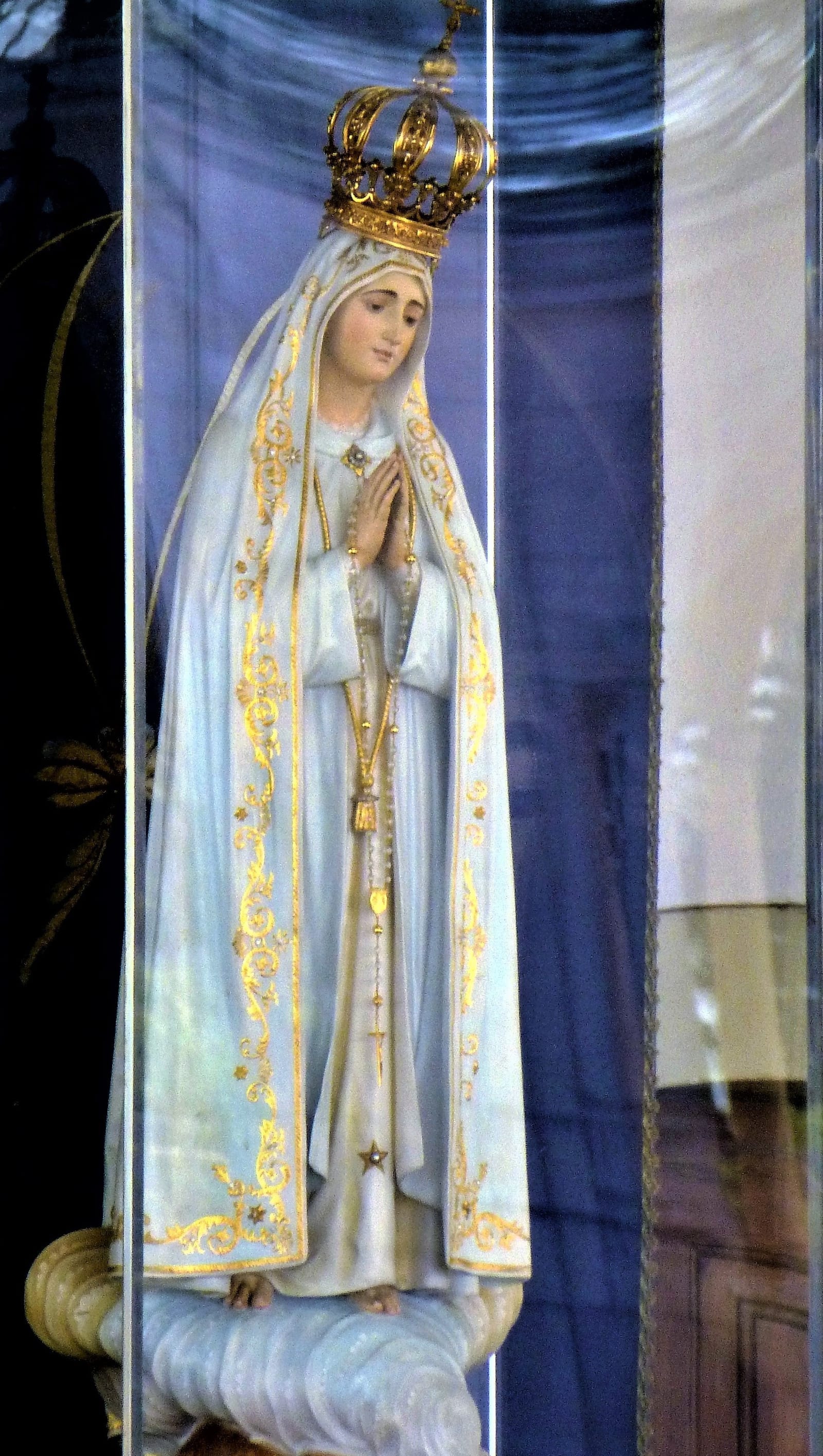
Six times in 1917 the Mother of God appeared to three shepherd children in a field in Portugal and asked for three things: devotion to her Immaculate Heart, the Communion of reparation on five First Saturdays, and the consecration of Russia. The apparitions themselves are catalogued with the other miracles. This page is about what happened next — the century in which popes, saints and twenty million ordinary people tried to answer her.
The angel, then the Lady
Three visits from an angel in 1916, then six from the Lady in 1917.
- Spring 1916
The Angel of Peace
A youth 'whiter than snow' appears to the three children at the Loca do Cabeço: 'Do not be afraid. I am the Angel of Peace.' He teaches them the prayer of pardon — 'My God, I believe, I adore, I hope and I love you…' — and tells them to pray it often.
Sister Lúcia's Memoirs - Summer 1916
The Angel of Portugal
At the well behind Lúcia's house the angel returns, names himself the guardian angel of Portugal, and asks for prayer and sacrifice: 'Offer prayers and sacrifices constantly to the Most High.'
Sister Lúcia's Memoirs - Autumn 1916
The Angel with the chalice
Holding a chalice with a Host suspended above it, from which drops of blood fall, the angel prostrates and teaches the prayer of reparation to the Trinity; then he gives the Host to Lúcia and the chalice to Francisco and Jacinta: 'Take and drink the Body and Blood of Jesus Christ, horribly outraged by ungrateful men.'
Sister Lúcia's Memoirs - 13 May 1917
The first apparition — the Cova da Iria
A Lady 'brighter than the sun' over a small holm oak. 'Do not be afraid. I will do you no harm… I come from heaven.' She asks the children to return on the thirteenth of each month for six months, asks whether they are willing to offer themselves to God and bear every suffering He sends in reparation for sin and for the conversion of sinners — and asks for the Rosary every day, for peace and the end of the war.
Sister Lúcia's Fourth Memoir - 13 June 1917
The Immaculate Heart is shown
'Jesus wishes to make use of you to make me known and loved. He wants to establish in the world devotion to my Immaculate Heart.' To Lúcia, who is told she will remain in the world for a long time: 'My Immaculate Heart will be your refuge and the way that will lead you to God.' The children see the Heart encircled by thorns.
Sister Lúcia's Fourth Memoir - 13 July 1917
The secret
The vision of hell; then the words that frame everything after: 'To save them, God wishes to establish in the world devotion to my Immaculate Heart.' A promise to return to ask for the consecration of Russia and the Communion of reparation on the First Saturdays. 'In the end, my Immaculate Heart will triumph.' And a promise: in October, a miracle 'so that all may believe.'
The Message of Fatima (Holy See, 2000), quoting the Third Memoir · read it - 19 August 1917
Valinhos — after the arrest
On 13 August the civil administrator, Artur de Oliveira Santos, seized the children and held them at Vila Nova de Ourém, threatening to boil them in oil; some 18,000 people had come to the Cova and saw only signs in the sky. Six days later Our Lady appears at Valinhos instead: 'Pray, pray very much, and make sacrifices for sinners; for many souls go to hell because there are none to sacrifice themselves and to pray for them.'
Sister Lúcia's Fourth Memoir - 13 September 1917
The fifth apparition
'Continue to pray the Rosary in order to obtain the end of the war. In October Our Lord will come, as well as Our Lady of Sorrows and Our Lady of Carmel, and Saint Joseph with the Child Jesus to bless the world.' Some 25,000–30,000 are present.
Sister Lúcia's Fourth Memoir - 13 October 1917
'I am the Lady of the Rosary' — and the Sun
'I want to tell you that a chapel is to be built here in my honour. I am the Lady of the Rosary. Continue always to pray the Rosary every day.' Then, before some 70,000 people in a downpour, the promised sign: the sun spins, throws colour, and plunges toward the crowd before returning to its place; soaked clothes and ground are found dry. The anti-clerical Lisbon daily O Século reports it the next morning.
Sister Lúcia's Fourth Memoir; contemporary press
The three requests
Her own words, and what each request became.
“To save them, God wishes to establish in the world devotion to my Immaculate Heart.”
What became of it: Pius XII consecrated the world to the Immaculate Heart in 1942 and gave the feast to the whole Church in 1944; it is kept the Saturday after the Sacred Heart.
The Immaculate Heart of Mary — the devotion →“I promise to assist at the hour of death, with the graces necessary for salvation, all those who, on the first Saturday of five consecutive months, go to confession, receive Holy Communion, recite five decades of the Rosary and keep me company for fifteen minutes while meditating on the mysteries, with the intention of making reparation to me.”
What became of it: Practised worldwide; it is the one Fátima request every Catholic can answer personally, and the Blue Army made it part of its pledge.
The Five First Saturdays →“The moment has come in which God asks the Holy Father, in union with all the bishops of the world, to make the consecration of Russia to my Immaculate Heart, promising to save it by this means.”
What became of it: Made, in stages, by five popes. Sister Lúcia wrote in 1989 that the act of 25 March 1984 was done 'just as Our Lady asked'; Francis named Russia and Ukraine in 2022.
The consecrations, 1942–2022 →The secret
Three parts, given on 13 July 1917; the third kept sealed until 2000.
- First part
The vision of hell
'Our Lady showed us a great sea of fire which seemed to be under the earth…' — and then: 'You have seen hell where the souls of poor sinners go. To save them, God wishes to establish in the world devotion to my Immaculate Heart.'
Third Memoir, 1941 · read it - Second part
War, Russia, and the triumph
'The war is going to end: but if people do not cease offending God, a worse one will break out during the pontificate of Pius XI… I shall come to ask for the consecration of Russia to my Immaculate Heart, and the Communion of reparation on the First Saturdays. If my requests are heeded, Russia will be converted, and there will be peace; if not, she will spread her errors throughout the world… In the end, my Immaculate Heart will triumph.'
Third Memoir, 1941 · read it - Third part
The bishop dressed in white
Written down by Lúcia in January 1944, sealed, read by John XXIII, Paul VI and John Paul II, and published by the Holy See on 26 June 2000 after Cardinal Sodano announced it at Fátima on 13 May: a vision of an angel with a flaming sword crying 'Penance, Penance, Penance!'; a 'Bishop dressed in White' — 'we had the impression it was the Holy Father' — climbing a mountain through a half-ruined city, past the dead, and killed at the foot of a great cross by soldiers, with bishops, priests, religious and laity; two angels gathering the blood of the martyrs. Cardinal Ratzinger's commentary reads it as a symbolic vision of the Church's twentieth-century persecutions, with the attempt on John Paul II on 13 May 1981 as its clearest referent.
The Message of Fatima, Holy See, 26 June 2000 · read it
The consecrations of Russia
Five popes, eighty years, and one letter from a Carmelite that the Church treats as the answer.
- 31 October 1942
Pius XII consecrates the world
In a radio message to Portugal for the silver jubilee of the apparitions, Pius XII consecrates the human race to the Immaculate Heart of Mary, with a veiled reference to 'those peoples' separated by error and discord. Russia is not named. He repeats the act in St. Peter's on 8 December.
Radio message of Pius XII, 31 October 1942 · read it - 7 July 1952
Pius XII names Russia
In the apostolic letter Sacro Vergente Anno, addressed to the peoples of Russia, Pius XII consecrates 'all the peoples of Russia' to the Immaculate Heart — naming Russia, but acting alone rather than with the bishops of the world.
Sacro Vergente Anno, 7 July 1952 - 21 November 1964
Paul VI, before the Council
Closing the third session of Vatican II, Paul VI proclaims Mary Mother of the Church and renews the consecration of the world to her Immaculate Heart in the presence of the Council fathers. Russia is not named.
Address closing the third session of Vatican II, 21 November 1964 - 13 May 1982
John Paul II at Fátima
One year after the bullet in St. Peter's Square, John Paul II goes to Fátima to thank Our Lady and makes an act of entrustment of the world — asking the bishops to join him. Sister Lúcia, present, later says the bishops had not been given time to unite with the act.
Homily and act of entrustment, Fátima, 13 May 1982 - 25 March 1984
John Paul II with the bishops of the world
In St. Peter's Square, before the statue of Our Lady brought from the Capelinha at Fátima, and in union with the bishops of the world, whom he had asked in advance to join him, John Paul II consecrates the world — 'especially those peoples for which you yourself are awaiting our consecration' — to the Immaculate Heart. Russia is not named aloud.
Act of Entrustment, 25 March 1984 - 8 November 1989
Sister Lúcia: 'Yes, it has been done'
Asked whether the 1984 act fulfilled Our Lady's request, Sister Lúcia writes: 'Yes it has been done just as Our Lady asked, on 25 March 1984.' The Holy See published the letter in 2000 as settling the matter.
Letter of Sister Lúcia, 8 November 1989, in The Message of Fatima (Holy See, 2000) · read it - 25 March 2022
Francis names Russia and Ukraine
A month into the invasion of Ukraine, at a penance service in St. Peter's Basilica, with the bishops of the world invited by letter to join, Francis prays: 'Mother of God and our Mother, to your Immaculate Heart we solemnly entrust and consecrate ourselves, the Church and all humanity, especially Russia and Ukraine.' Cardinal Krajewski makes the same act at Fátima the same day. It is the first time both nations are named.
Act of Consecration to the Immaculate Heart of Mary, 25 March 2022 · read it
The Church's verdicts
What the Church has actually said, and when.
- 13 October 1930
Declared worthy of belief
After a seven-year canonical inquiry, José Alves Correia da Silva, Bishop of Leiria, declares the visions of the children at the Cova da Iria worthy of belief and authorises the cult of Our Lady of Fátima.
Pastoral letter A Divina Providência, 13 October 1930 - 13 May 1967
Paul VI comes as a pilgrim
On the fiftieth anniversary Paul VI travels to Fátima — the first pope to do so — and meets Sister Lúcia at the shrine.
Apostolic journey of Paul VI to Fátima, 13 May 1967 - 13 May 2000
Francisco and Jacinta beatified; the third secret announced
John Paul II beatifies the two Marto children at Fátima, with Sister Lúcia present; at the close of the Mass Cardinal Sodano announces that the third part of the secret will be published.
Beatification homily and announcement, Fátima, 13 May 2000 - 13 May 2010
Benedict XVI: the mission is not complete
'We would be mistaken to think that Fatima's prophetic mission is complete… May the seven years which separate us from the centenary of the apparitions hasten the fulfilment of the prophecy of the triumph of the Immaculate Heart of Mary.' On the flight there, of the third secret: the Church's sufferings 'come precisely from within the Church, from the sin existing within the Church.'
Homily at Fátima, 13 May 2010; interview on the papal flight, 11 May 2010 · read it - 13 May 2017
Francisco and Jacinta canonized
On the centenary, Francis canonizes Francisco and Jacinta Marto at the shrine — the youngest non-martyr saints in the Church's history.
Canonization homily, Fátima, 13 May 2017 · read it - 22 June 2023
Sister Lúcia declared Venerable
Francis authorises the decree recognising the heroic virtue of Sister Maria Lúcia of Jesus and the Immaculate Heart, who died at the Coimbra Carmel on 13 February 2005 at ninety-seven.
Decree of the Dicastery for the Causes of Saints, 22 June 2023 · read it
The Blue Army — the World Apostolate of Fátima
The apostolate that grew up to carry the message — recognised by the Holy See.
In 1946 Monsignor Harold Colgan, pastor of St. Mary's in Plainfield, New Jersey, lay in hospital with a failing heart and vowed to Our Lady that if he lived he would spend his life spreading her Fátima message. He lived. Back in his parish he called his people to be 'the Blue Army of Mary and Christ, against the red army of the world and of Satan' — blue for Mary, against the red of the Communism that Our Lady had named at Fátima — and gave each of them a blue ribbon or medal to wear.
A young layman, John Haffert, had already been to Portugal. On 12 August 1946, with the Bishop of Leiria's permission, he interviewed Sister Lúcia at her Dorothean convent in Porto and asked her what, exactly, Our Lady wanted of ordinary people. Her answer became the pledge: the Rosary each day, the scapular as the sign of consecration to her Immaculate Heart, and the offering of the sacrifices that daily duty demands — 'the basic things which must be done.' Colgan and Haffert founded the Blue Army in 1947. It had a million members by 1950 and five million by 1953; the apostolate today reports more than twenty million in over a hundred countries.
Under John Paul II the movement took the name World Apostolate of Fátima to mark that it is an apostolate of the Church rather than a private campaign. Its international secretariat is at Fátima itself, in the Domus Pacis; its American home is the National Blue Army Shrine of the Immaculate Heart of Mary at Washington, New Jersey — Haffert's old farm, with an exact replica of the Capelinha and a replica of the Holy House of Loreto — which draws some fifty thousand pilgrims a year.
- ✦To pray five decades of the Rosary each day, meditating on the mysteries.
- ✦To wear the brown scapular of Mount Carmel as the sign of consecration to the Immaculate Heart of Mary.
- ✦To offer up the sacrifices demanded by daily duty, extending the Morning Offering through the day, in reparation and for the conversion of sinners.
- ✦And, added later: the Five First Saturdays — confession, Communion, the Rosary and fifteen minutes' meditation in reparation to the Immaculate Heart.
Recognised by the Church
- 13 October 1956
First international statutes
The first International Statutes of the Blue Army are adopted and submitted to the Holy See, which approves them ad experimentum.
World Apostolate of Fátima, official history · read it - 7 October 2005
Recognised by the Holy See
On the feast of Our Lady of the Rosary, the Pontifical Council for the Laity recognises the World Apostolate of Fátima as a public international association of the faithful and approves its statutes for five years ad experimentum; the decree is formally consigned in Rome on 3 February 2006.
Pontifical Council for the Laity, 7 October 2005 · read it - 7 October 2010
Definitive approval
By a decree dated 7 October 2010 (Prot. 1289/10/AIC-76), the Pontifical Council for the Laity confirms the apostolate as a public association of the faithful with juridical personality and definitively approves its statutes.
Decree of the Pontifical Council for the Laity, 7 October 2010 · read it
The Pilgrim Virgin
On 13 May 1947 the sculptor José Ferreira Thedim — who had made the original statue of the Capelinha in 1920 — completed a new image made in consultation with Sister Lúcia, who corrected the details of the mantle and tunic. It was blessed at Fátima, and a second was blessed by the Bishop of Leiria on 13 October 1947, thirty years to the day after the Miracle of the Sun, and entrusted to John Haffert with the prayer that Mary herself accompany it wherever it went.
That is the International Pilgrim Virgin Statue. It has travelled more than a hundred countries in seventy-five years, been received by popes, and is the image most Catholics picture when they hear the word Fátima.
Still argued
Two questions faithful Catholics still put to each other, with both sides stated properly.
Did the consecration of 25 March 1984 fulfil the request?
Yes: Sister Lúcia said so in writing on 8 November 1989 — 'just as Our Lady asked' — and confirmed it in later conversations; the Holy See published the letter in 2000 as closing the question; the Soviet Union dissolved within seven years, which many read as the promised fruit.
No: Russia was not named aloud in 1984, and Lúcia had earlier said acts that did not name Russia or lack the bishops' union were insufficient; a minority holds that the request has not yet been met in its exact form, even after 2022.
Where the Church stands: The Church's answer is Lúcia's own: it has been done. Francis's 2022 act, which named Russia, was framed by the Holy See as a renewal in a moment of war, not as a correction. Catholics may still discuss the point; they may not present the 1984 act as invalid on the Church's authority, because the Church says the opposite.
Is the text published in 2000 the whole third secret?
Yes: The Holy See published the manuscript in facsimile with Cardinal Ratzinger's commentary; Cardinal Bertone, who read it to Sister Lúcia in Coimbra, reports that she confirmed it was the whole; Benedict XVI never said there was more.
No: The published text is a vision without any words of Our Lady, though the second part ends 'In Portugal the dogma of the faith will always be preserved etc.' — an 'etc.' some believe introduces a further, unpublished explanation; Antonio Socci and others argue a second sheet exists. Benedict's 2010 remarks that the vision points to 'realities involving the future of the Church, which are gradually taking shape' were read by some as reopening the question.
Where the Church stands: The Holy See's position is unambiguous: everything has been published. The site records the dissent because it is widespread, not because it is weighty; no evidence of a second text has ever been produced.
What binds a Catholic
- ♥Fátima is a private revelation. No Catholic is obliged in conscience to believe that Our Lady appeared at the Cova da Iria — the Church has judged the apparitions worthy of belief, which is a permission, not a command.
- ♥What the message asks — prayer, penance, the Rosary, reparation, devotion to the Immaculate Heart — binds because the Gospel asks it, not because Fátima does. That is exactly why the Church could approve it: it contains nothing new.
- ♥Every pope from Pius XII to Francis has honoured Fátima, four have gone there as pilgrims, and the Church has canonized two of the seers. A Catholic may hold Fátima lightly; a Catholic may not hold it in contempt.
Our Lady around the world
Fátima is one of a long line. These are the apparitions on this site — the visits where she appeared and spoke — in order, with the Church's judgment on each. The pattern is the same in every century: prayer, penance, the Rosary, and a mother's warning.
Each card is the catalogue's own entry; the miraculous images of the Americas — Aparecida, Luján, El Cobre, Caacupé, Copacabana — are a different kind of event and are catalogued with the miracles.
Follow it further
Every date and quotation on this page was checked against the document it names before it was written, and linked where a public text exists. Our Lady's words are Sister Lúcia's own text as published by the Holy See in 2000. Where Catholics of good faith still disagree, the page says so and gives both sides.